
 Anne V. Coates: Film editor.

‘Perspectives on Editing’: Animation
Sept. 23: The art and craft of editing animated films will be explored in the second installment of the Academy of Motion Picture Arts and Sciences’ four-part seminar series “Perspectives on Editing” on Tuesday, Sept. 29, from 7 to 10 p.m. at the Academy’s Linwood Dunn Theater in Hollywood.
“Perspectives on Editing: Editing for Animation” will be hosted by Academy Film Editors Branch governors Donn Cambern (The Last Picture Show, The Bodyguard) and Mark Goldblatt (Terminator 2: Judgment Day, Starship Troopers).
Special guests will include Kent Beyda (Alien Nation, Scooby-Doo), John Carnochan (Ice Age, The Simpsons Movie), Nancy Frazen (Runaway Brain, Surf’s Up), Lois Freeman-Fox (Fantasia/2000, Osmosis Jones), and Kevin Nolting (Up).
Each “Perspectives on Editing” evening will feature film clips and a discussion between the special guests and members of the audience.
The schedule for subsequent sessions is as follows, with all participants subject to availability:
Tuesday, Oct. 6 – Editing for Documentary Films
A discussion with Kate Amend (The Long Way Home, Jimmy Carter Man from Plains), Joe Bini (Little Dieter Needs to Fly, Grizzly Man), William Cartwright (The Making of the President 1960, Maya Lin: A Strong Clear Vision) and Brian Johnson (Buena Vista Social Club, Fighting for Life).
Wednesday, Oct. 14 – Anne V. Coates: Profile of an Editing Master
A discussion with Coates, who received her first nomination and Oscar for Film Editing for Lawrence of Arabia (1962). Since then she has received four additional nominations, for Becket (1964), The Elephant Man (1980), In the Line of Fire (1993) and Out of Sight (1998).
Tickets for each evening of “Perspectives on Editing” are $10 for the general public and $7.50 for Academy members and students with a valid ID. Tickets may be purchased by mail, in person at the Academy during regular business hours or online at www.oscars.org.
The Academy’s Linwood Dunn Theater is located at 1313 Vine Street in Hollywood. For more information, call (310) 247-3600.
 Oscar-winning film editor Walter Murch (center), with Oscar-nominated film editors Mark Goldblatt (left) and Donn Cambern.
‘A Conversation with Walter Murch’: Academy series focuses on Oscar-winning film editor
Sept. 28: The Academy of Motion Picture Arts and Sciences has made available images from the event “A Conversation with Walter Murch,” which was part of the Academy’s “Perspectives on Editing” series. The Walter Much interview was held on Tuesday, Sept. 22, at the Linwood Dunn Theater in Hollywood.
Besides Murch, also in attendance were Academy governors and Oscar-nominated film editors Mark Goldblatt (Terminator 2: Judgment Day, 1991) and Donn Cambern (Romancing the Stone, 1984).
More images from “A Conversation with Walter Murch” further below.
Walter Murch movies
Among Walter Murch’s film editing credits are Fred Zinnemann’s Julia (1977); Jerry Zucker’s Ghost (1990); Francis Ford Coppola’s The Godfather Part III (1990) and Youth Without Youth (2007); and Anthony Minghella’s The English Patient (1996), The Talented Mr. Ripley (1999), and Cold Mountain (2003).
Only one of Murch’s three Academy Awards was for film editing: The English Patient (1996). The other two were for Best Sound:
- The English Patient, shared with Mark Berger, David Parker, and Christopher Newman.
- Apocalypse Now (1979), shared with Mark Berger, Richard Beggs, and Nathan Boxer.
Perspectives on Editing: Editing for Documentary Films
Sept. 30: The art and craft of editing documentary films is the topic of the third installment of the Academy of Motion Picture Arts and Sciences’ four-part seminar series “Perspectives on Editing,” which will be held on Tuesday, October 6, from 7 to 10 p.m. at the Academy’s Linwood Dunn Theater in Hollywood.
“Perspectives on Editing: Editing for Documentary Films” will be hosted by Academy Film Editors Branch governors Donn Cambern (The Last Picture Show, The Bodyguard) and Mark Goldblatt (Terminator 2: Judgment Day, Starship Troopers).
Special guests will include Kate Amend (The Long Way Home, Jimmy Carter Man from Plains), Joe Bini (Little Dieter Needs to Fly, Grizzly Man), William Cartwright (The Making of the President 1960, Maya Lin: A Strong Clear Vision) and Brian Johnson (Buena Vista Social Club, Fighting for Life). Like in the other installments in the series, the evening will feature film clips and an open discussion between the special guests and members of the audience.
The final session in the series will take place on Wednesday, October 14, and it’s titled “Anne V. Coates: Profile of an Editing Master.” The evening will feature a discussion with Anne Coates, who won an Oscar for editing Lawrence of Arabia (1962). Coates has received four additional nominations, for Becket (1964), The Elephant Man (1980), In the Line of Fire (1993) and Out of Sight (1998).
Animation Editors Kevin Nolting, Nancy Frazen at ‘Perspectives on Editing’
Oct. 2: The Academy of Motion Picture Arts and Sciences presented “Editing for Animation” as part of its “Perspectives on Editing” series on Tuesday, September 29, at the Linwood Dunn Theater in Hollywood.
Pictured above prior to the event (left to right): Nancy Frazen (Surf’s Up), Kent Beyda (Scooby-Doo), Academy governor Mark Goldblatt (seated), Academy governor Donn Cambern (seated), Lois Freeman-Fox (Fantasia/2000), Kevin Nolting (Finding Nemo) and John Carnochan (Beauty and the Beast).

Kevin Nolting
Anne V. Coates: Profile of an Editing Master
Oct. 8: Legendary film editor Anne Coates, 83, will be the subject of the Academy of Motion Picture Arts and Sciences’ “Perspectives on Editing – Anne Coates: Profile of an Editing Master” on Wednesday, Oct. 14, from 7 to 10 p.m. at the Academy’s Linwood Dunn Theater in Hollywood.
This fourth and last installment of the Academy’s “Perspectives on Editing” series will be once again hosted by the Academy Film Editors Branch governors Donn Cambern (The Last Picture Show, The Bodyguard) and Mark Goldblatt (Terminator 2: Judgment Day, Starship Troopers).
“Anne Coates: Profile of an Editing Master” will feature a discussion with Coates, who won an Oscar for editing Lawrence of Arabia (1962). Additionally, she received Oscar nods for Becket (1964), The Elephant Man (1980), In the Line of Fire (1993), and Out of Sight (1998).
Among Anne Coates’ other film editing credits are The Pickwick Papers (1952), The Horse’s Mouth (1958), Tunes of Glory (1960), Young Cassidy (1965), Murder on the Orient Express (1974), The Eagle Has Landed (1977), Greystoke: The Legend of Tarzan, Lord of the Apes (1984), Chaplin (1992), Erin Brockovich (2000), Unfaithful (2002), The Golden Compass (2007), and the upcoming Harrison Ford vehicle Extraordinary Measures (2010).
Throughout her nearly six-decade film career, Coates has collaborated with numerous top directors on both sides of the Atlantic, including Ronald Neame, Sidney Lumet, David Lean, Steven Soderbergh, Wolfgang Petersen, Richard Attenborough, and David Lynch.
Note: “Perspectives on Editing – Anne Coates: Profile of an Editing Master” is sold out. A standby line will form on the day of the event, and standby numbers will be assigned at approximately 5:30 p.m. Any available tickets will be distributed shortly before the program begins. Advance ticket holders should plan to arrive at least 15 minutes before the start of the event to ensure a seat in the theater.
Editors Brian Johnson & William Cartwright at Academy Seminar
Oct. 8: The Academy of Motion Picture Arts and Sciences presented “Editing for Documentary Films” as part of the series “Perspectives on Editing” on Tuesday, October 6, at the Linwood Dunn Theater in Hollywood.
Pictured above prior to the event (left to right): Brian Johnson (Buena Vista Social Club, Fighting for Life), Academy governor Mark Goldblatt, Joe Bini (Little Dieter Needs to Fly, Grizzly Man), Kate Amend (The Long Way Home, Jimmy Carter Man from Plains), William Cartwright (The Making of the President 1960, Maya Lin: A Strong Clear Vision), and Academy governor Donn Cambern.
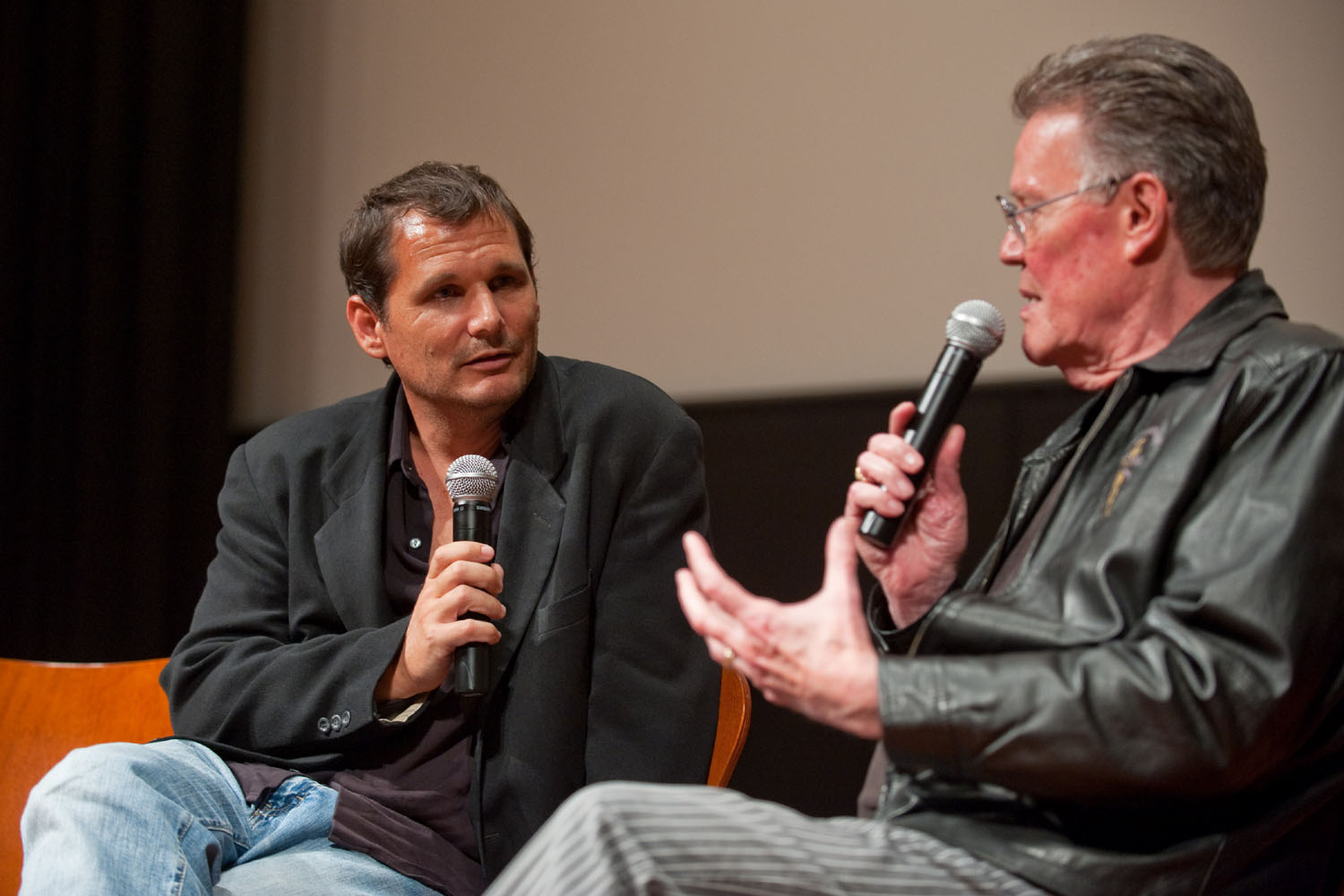
Brian Johnson, Donn Cambern
Academy of Motion Picture Arts and Sciences (A.M.P.A.S.) website.
Film editors Mark Goldblatt, Walter Murch, Donn Cambern images: Todd Wawrychuk | © A.M.P.A.S.
Brian Johnson, Donn Cambern, and Joe Bini images: Greg Harbaugh | © A.M.P.A.S.

“Linwood Dunn: Celebrating a Visual Effects Pioneer,” will explore the work of special effects artist Linwood Dunn, including the techniques he used in creating optical effects for Orson Welles’ Citizen Kane, on Friday, October 9, at 8 p.m. at the Academy of Motion Picture Arts and Sciences’ appropriately named Linwood Dunn Theater in Hollywood. A newly struck print of Citizen Kane from the Academy Film Archive will be screened. This event is sold out, but standby tickets may become available.
Presented by the Academy’s Science and Technology Council, “Linwood Dunn” will be hosted by Oscar-winning visual effects artist and Academy governor Craig Barron. The evening will also feature an onstage discussion with Dunn’s daughter, Nancy Dunn; Paramount technology executive Garrett Smith, who was mentored by Dunn; and visual effects artists who were influenced by his work, including Jonathan Erland, Michael Fink and Bill Taylor. All that, plus rare recorded interviews with Dunn.
Among Linwood Dunn’s credits in various optical effects capacities are Cimarron (1931), King Kong (1933), Cat People (1942), Mighty Joe Young (1949), The Thing from Another World (1951), West Side Story (1961), Hawaii (1966), for which he earned a Special Visual Effects Oscar nomination, The Exorcist (1973), and the TV series Star Trek.
Dunn was honored by the Academy in 1944 and in 1980 for the Acme-Dunn Optical Printer he designed in the 1940s with machinist Cecil Love. In 1978 Dunn earned the Academy’s Medal of Commendation, and took home the Gordon E. Sawyer Award in 1984 “for his lifetime of contributions to the art and technology of motion pictures.” The Linwood Dunn Theater at the Academy’s Pickford Center for Motion Picture Study was dedicated in his honor in 2004, six years after his death.
As per the Academy’s press release, “Dunn introduced Welles to the optical printer during production of Citizen Kane, and under Welles’ direction the device was used ‘like a paintbrush’ to help drive the visual narrative of the film. Instead of jarring cuts, optical dissolves were used to slip between scenes, and sometimes between shots within scenes; during post-production, new elements such as miniature effects and matte painting were added to previously photographed scenes on an unprecedented scale. These effects, together with Gregg Toland’s cinematography, made Citizen Kane a visual masterpiece.”
Citizen Kane was nominated for nine Academy Awards; it won one Oscar for best original screenplay (Welles, Herman J. Mankiewicz). Also in the Citizen Kane cast: Joseph Cotten, Dorothy Comingore, Agnes Moorehead, Ruth Warrick, Ray Collins, George Coulouris, Paul Stewart, Fortunio Bonanova, and Everett Sloane.
Though “Linwood Dunn: Celebrating a Visual Effects Pioneer” is sold out, additional tickets typically become available at the last minute due to no-shows and cancellations. There will be a standby line at the west doors of the Pickford Center on October 9. Standby numbers will be given out at approximately 5:30 p.m. The number of standby tickets that can be sold will be determined shortly before the event’s 8 p.m. start time.
Tickets to Citizen Kane are $5 for the general public and $3 for Academy members and students with a valid ID.
The Linwood Dunn Theater is located at 1313 Vine Street in Hollywood. For more information call (310) 247-3600 or visit www.oscars.org.
Photos: Courtesy of the Margaret Herrick Library.
Oscar winners, horror movies, and silent shorts are all part of the Library of Congress Packard Campus for Audio Visual Conservation’s fall film series in Culpeper, Va., starting Oct. 8.
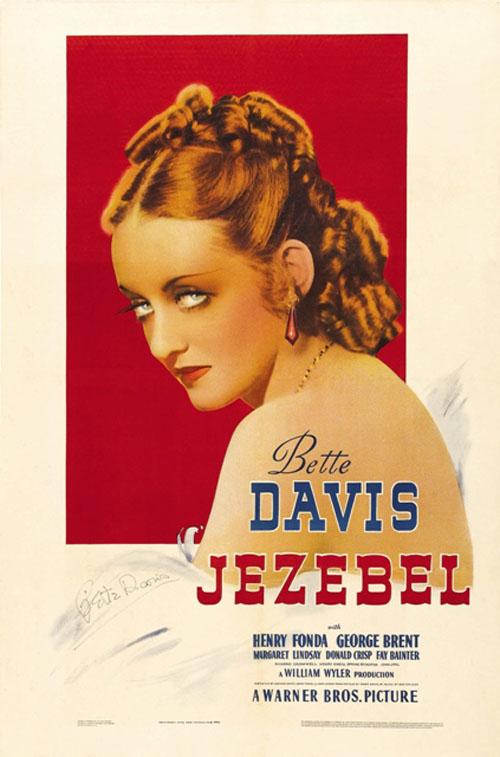
Among the Oscar winners is best actress Bette Davis in Jezebel (1938), William Wyler’s classic romantic melodrama that was Warner Bros.’ answer to Gone with the Wind. (The film was based on a flop play that starred Miriam Hopkins, Bette Davis’ future archrival.) Davis was one of the top contenders for the role of Scarlett O’Hara, but had to content herself with playing Jezebel’s wilful Southern belle – who dares to wear a red dress (in black and white) at a ball much to the shock and awe of the present guests. (Sometimes I wonder if this was inspired by the time when Norma Shearer dared to wear a red dress [in color] at a mid-30s, all-white Hollywood party much to the anger and consternation of the other female guests.) Fellow Oscar winner Fay Bainter, Henry Fonda, George Brent, and Margaret Lindsay are also in Jezebel.
There are three horror movies lined up: Alien (1979, above), Ridley Scott’s scary-as-hell classic about a ravenous spaceship stowaway; Mario Bava’s Black Sunday, starring horror cult icon Barbara Steele as a burned-alive Bavarian princess who returns from the dead to exact revenge on her family; and Robin Hardy’s The Wicker Man (1973), an atmospheric drama involving a law-and-order police sergeant, lots of hippies, and a missing girl that no one seems to have heard of. I saw this one a while back, and despite its reputation I must admit I wasn’t able to get into it. I need to check it out again. Edward Woodward stars as the sergeant. Britt Ekland and Christopher Lee costar.
And of special interest is an all-shorts program celebrating the 100th anniversary of the Thanhouser Company, one of the early silent film studios. Andrew Simpson will provide live musical accompaniment and Ned Thanhouser, the grandson of the founders of the company, will make a personal appearance. Among the Thanhouser stars of the 1910s were James Cruze (best known for directing the 1923 Western classic The Covered Wagon), Marguerite Snow, Florence LaBadie, William Russell, Frederick Warde, and Broadway legend Jeanne Eagels. (Poster: Thanhouser.org.)
Short subjects will be presented before select programs. Titles are subject to change without notice. All Packard Campus programs are free and open to the public. For more information, visit the Library of Congress website.
In the San Francisco Examiner, Thomas Gladysz talks about the recently released biography of silent film comedian Lloyd Hamilton:
“Chances are, if you’re a fan of early film or early comedic actors, you’re only dimly aware of Lloyd Hamilton. Though he was never as popular as his silent film contemporaries Charlie Chaplin, Buster Keaton and Charley Chase, he was admired and even praised by those same greats. Some have called Hamilton a ‘comedian’s comedian.’ And pretty much everyone who has seen his films agrees he was an original talent.
“The reputation of Lloyd Hamilton – a once popular baby-faced comic with a trademark checkered cap – has not fared well since his death at the age of 43 in 1935. The reasons why are many.”
***
Among the reasons cited by Gladysz are Hamilton’s alcoholism, a troubled private life, and changing audience tastes. For my part, I’m totally unfamiliar with Lloyd Hamilton’s work, though I’m quite sure I’ve seen him host one of the “Screen Snapshots” shorts of the early 1930s.
First-time author Anthony Balducci’s Lloyd Hamilton: Poor Boy Comedian of Silent Cinema is being published by McFarland.
thanhouser-company