
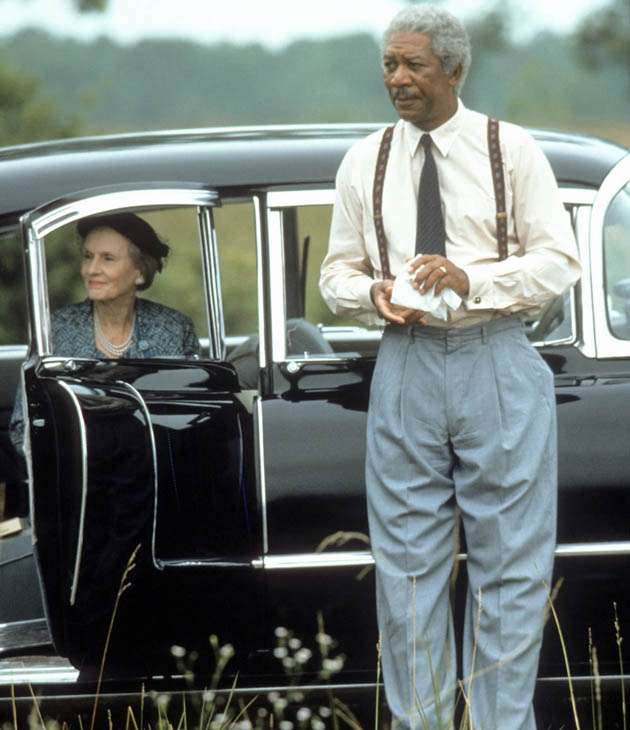
 Driving Miss Daisy with Jessica Tandy and Morgan Freeman. Bruce Beresford’s film version of Alfred Uhry’s Pulitzer Prize-winning Off-Broadway play was the first Best Picture Academy Award winner in nearly six decades without a matching Best Director nomination. Jessica Tandy, for her part, became the oldest winner ever in the acting categories.

Driving Miss Daisy Academy Screening
Driving Miss Daisy, Bruce Beresford’s 1989 Best Picture Oscar winner, will be the final 2010 presentation in the Academy of Motion Picture Arts and Sciences’ “Monday Nights with Oscar” film series.
Starring Best Actress Oscar winner Jessica Tandy, and nominees Morgan Freeman and Dan Aykroyd, Driving Miss Daisy will be screened on Monday, Dec. 13, at 7 p.m. at the Academy Theater at Lighthouse International in New York City.
Alfred Uhry, who won an Oscar for his adaptation of his Pulitzer Prize-winning play – reportedly inspired by the story of his own grandmother – is scheduled to join Bruce Beresford in an onstage discussion about the play’s journey from Off-Broadway hit to Best Picture winner.
Dana Ivey & Morgan Freeman in original Off-Broadway cast
The current Driving Miss Daisy revival, starring Vanessa Redgrave and James Earl Jones, marked the play’s Broadway debut.
Dana Ivey, Morgan Freeman, and Ray Gill starred in the original stage production, while Best Supporting Actress Oscar winner Wendy Hiller (Separate Tables, 1958), Clarke Peters, and Barry Foster toplined the West End cast.
Set in Atlanta at the dawn of the Civil Rights Movement, Uhry’s highly sentimental drama tells the story of an elderly Jewish woman (Jessica Tandy) who, after wrecking her car, is befriended by her newly hired black driver (Morgan Freeman). Dan Aykroyd plays the woman’s son.
Also in the Driving Miss Daisy cast: Patti LuPone, Esther Rolle, Joann Havrilla, and William Hall Jr.
‘Notable bits of Oscar history’
According to the Academy’s press release, Driving Miss Daisy “produced two notable bits of Oscar history”:
- It was the first time a movie based on an Off-Broadway play received the Best Picture Academy Award.
- At age 81, Jessica Tandy became the oldest performer to win a competitive Oscar. More than four decades earlier, Tandy had created the role of Blanche DuBois in Tennessee Williams’ A Streetcar Named Desire on Broadway. Elia Kazan directed both the play and the 1951 film version starring eventual Best Actress Oscar winner Vivien Leigh.
Additionally, Driving Miss Daisy was the first Best Picture winner without a matching Best Director nomination since Edmund Goulding’s Grand Hotel back in the period 1931–1932.
Tickets for Driving Miss Daisy are $5 for the general public and $3 for Academy members and students with a valid ID. The Academy Theater is located at 111 East 59th Street in New York City. For more information, visit www.oscars.org.
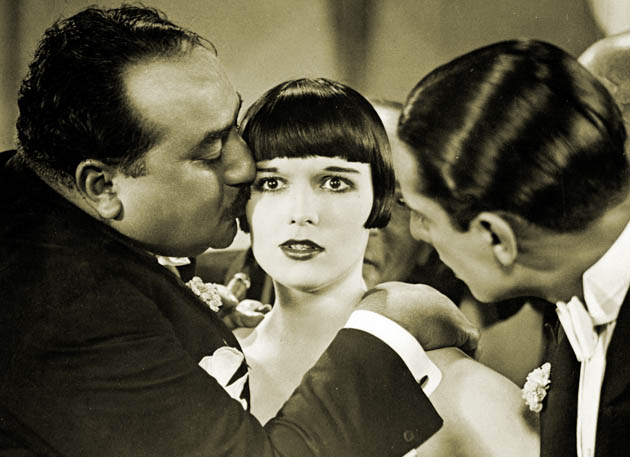 Diary of a Lost Girl with Louise Brooks. G.W. Pabst’s silent film classic will be screened at the National Gallery of Art in Washington, D.C. One of the few – relatively speaking – well-remembered silent era stars, Louise Brooks would in all likelihood have been as forgotten as much bigger names like Corinne Griffith, Norma Talmadge, Ruth Roland, and Laura La Plante if it weren’t for two frequently shown, G.W. Pabst-directed silent classics made in Europe right at the dawn of the sound era: Pandora’s Box (1929) and Diary of a Lost Girl (1929).
Diary of a Lost Girl screening: G.W. Pabst and Louise Brooks classic
The year 2011 will start with a silent bang in Washington, D.C., as the 1929 silent era classic Diary of a Lost Girl / Tagebuch einer Verlorenen, directed by G.W. Pabst (sometimes billed as Georg Wilhelm Pabst) and starring Louise Brooks, will be screened on Jan. 2 at 4:30 p.m. at Washington’s National Gallery of Art.
The presentation will feature live musical accompaniment by the Irish ensemble 3epkano, which will perform their own original score for the film.
Here’s what Louise Brooks Society founder Thomas Gladysz has to say at examiner.com:
Diary of a Lost Girl tells the story of Thymian, a young woman forced by circumstance into a life of prostitution. The film was based on a once controversial book by the German novelist Margarete Böhme. Though little known today, The Diary of a Lost Girl was a literary sensation when first published in 1905. One contemporary scholar has called it ‘Perhaps the most notorious and certainly the [most commercially] successful autobiographical narrative of the early twentieth century.’
‘Louise Brooks edition’ of Margarete Böhme’s book
The heavily censored Diary of a Lost Girl was the second time Hollywood actress Louise Brooks worked with G.W. Pabst in Germany. The duo had previously collaborated on Pandora’s Box / Die Büchse der Pandora (also released in 1929), probably the actress’ best-remembered effort.
Gladysz recently edited and wrote the introduction to the “Louise Brooks edition” of Margarete Böhme’s book. He will be talking about his new effort at the Village Voice Bookshop in Paris on Jan. 13. That will be followed by a screening of Diary of a Lost Girl at the nearby Action Cinema.
National Gallery of Art website.
Jessica Tandy and Morgan Freeman Driving Miss Daisy image: Courtesy of the Margaret Herrick Library.
Louise Brooks Diary of a Lost Girl image: Pabst-Film.
*last modified in July 2025.
louise-brooks-g-w-pabst-diary-of-a-lost-girl-screening