
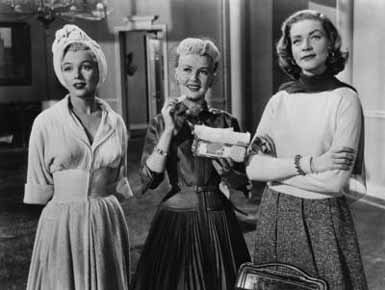
 How to Marry a Millionaire with Marilyn Monroe, Betty Grable, and Lauren Bacall: Three little girls on the prowl. Image: © A.M.P.A.S.

One of the earliest examples of CinemaScope, How to Marry a Millionaire is an enjoyable romp starring three of Hollywood’s brightest stars of the 1950s: Betty Grable, Marilyn Monroe, and Lauren Bacall.
The film will be screened as part of the “Monday Nights with Oscar” series in New York City on Sept. 11. See “Press Release” below.
How to Marry a Millionaire follows an old Fox formula (inspired by the stage play The Greeks Had a Word for Them) that was recycled every few years – three good-looking women look for rich husbands – in movies like Three Blind Mice (1938), Moon Over Miami (1941), and Three Little Girls in Blue (1946).
How to Marry a Millionaire was a respectable box office success, and it marked the change of the guard at Fox: Betty Grable, the studio’s top star of the 1940s, was about to pass the Queen of the Lot title to the younger Marilyn Monroe. Though still highly popular, Grable was to retire from films a mere two years later.
Note: The Greeks Had a Word for Them was filmed in 1932. It was produced by Samuel Goldwyn, and released by United Artists. Joan Blondell, Ina Claire, and Madge Evans played the three golddiggers.
The three girls in Three Blind Mice were Loretta Young, Marjorie Weaver, and Pauline Moore. In Moon Over Miami they were Betty Grable, Carole Landis, and Charlotte Greenwood (though hardly a girl by then, but still plugging along); and in Three Little Girls in Blue, June Haver, Vivian Blaine, and Vera-Ellen.
Press Release:
New York, NY – Oscar®-nominated actress Lauren Bacall will be the special guest at the “Monday Nights with Oscar” screening of How to Marry a Millionaire, on Monday, September 11, at 7:30 p.m. at the Academy Theater at Lighthouse International in New York City.
Bacall will participate in a post-screening discussion moderated by Robert Osborne, The Hollywood Reporter columnist, host of Turner Classic Movies and official biographer of the Academy Awards®.
How to Marry a Millionaire, starring Bacall, Marilyn Monroe and Betty Grable, tells the story of three couturier models who lease a posh Sutton Place apartment in New York City in their search for eligible millionaires. Along the way, they discover love, and perhaps their real fortunes, in the most unlikely fellows.
The film also stars three-time Academy Award nominee William Powell as J.D. Hanley, the millionaire who falls for Schatze Page (Bacall). David Wayne and Rory Calhoun costar as Freddie Denmark and Eben Salem, respectively.
Directed by Academy Award nominee Jean Negulesco (Johnny Belinda), the 1953 film is based on the plays The Greeks Had a Word for It (1930) by Zoe Akins and Loco (1946) by Dale Eunson and Katherine Albert. It was adapted for the screen and produced by Nunnally Johnson.
How to Marry a Millionaire earned an Academy Award nomination for Color Costume Design for 20th Century Fox wardrobe director Charles LeMaire, a 16-time Academy Award nominee and winner for All about Eve, The Robe and Love Is a Many-Splendored Thing, and Travilla (William “Bill” Travilla), a four-time Oscar nominee and winner for Adventures of Don Juan. Travilla was also known for designing Monroe’s costumes.
The print for this screening, recently restored by 20th Century Fox and added to the Academy Film Archive collection, begins with a six-minute sequence of composer Alfred Newman conducting the 20th Century Fox Symphony Orchestra as it plays part of the score he wrote for Street Scene, the 1931 United Artists release.
The Academy Theater at Lighthouse International is located at 111 East 59th Street in New York City. Tickets for the screening are $5 for the general public and $3 for Academy members and students with a valid ID.
Tickets may be reserved by calling 1-888-778-7575. Depending on availability, tickets may be purchased the night of the screening. Doors open at 7 p.m. For more information, visit www.oscars.org/events.

Finis terrae (1929): Jean Epstein classic at London’s Barbican
Jean Epstein, best known for his 1928 Gothic silent classic The Fall of the House of Usher, was also responsible for the naturalistic semi-documentary Finis terrae (1929), which will be screened at 3 p.m. on September 17 at London’s Barbican Centre. According to the Barbican website, Curt Collective will provide musical accompaniment to Finis terrae, featuring a “daring” new score that “uses oboe, clarinet, trombone, guitars, percussion, electronics and voices, spoken and sung.”
Shot on the coast of Brittany, Finis terrae portrays the hardships faced by Breton fishermen and coastal kelp-harvesters. The cast is composed of non-professional actors: as per the IMDb, François Morin and Jean-Marie Laot, among others. The Latin phrase Finis terrae, by the way, means “the end of the world” or “where the land ends.”
Jean Epstein movies
Jean Epstein directed nearly forty films, including both shorts and features, narrative and documentary works, from the early ’20s to the late ’40s. Besides The Fall of the House of Usher and Finis terrae, Epstein’s movie credits include the 1923 film version of Honoré de Balzac’s The Red Inn / L’auberge rouge, with Léon Mathot and Gina Manès; La châtelaine du Liban (“The Chatelaine of Lebanon,” 1934), with Jean Murat and Spinelly; and the mix of adventure, fantasy, and drama La femme du bout du monde (“The Woman from the End of the World,” 1938), with Charles Vanel, Germaine Rouer, and Jean-Pierre Aumont.
Dmitri Shostakovich movies at the Barbican
Also at the Barbican: From Sept. 23-Dec. 10, the Barbican Centre will screen “the biggest season of Shostakovich’s work on film ever presented” in the United Kingdom. Dmitri Shostakovich, one of the most renowned Russian composers of the twentieth century, created scores for numerous films.
Among those to be screened at the Barbican are Sergei Yutkevich and Fridrikh Ermler’s 1932 political propaganda-cum-love story The Counterplan / Vstrechnye (Sept. 23); Albert Gendelshtein’s 1935 post-Revolution civil war drama Love and Hate / Lyubov i nenavist (Oct. 8); and Alexander Faintsimmer’s 1955 drama Ovod / The Gadfly (Dec. 10), the tale of a nineteenth-century Italian revolutionary who rebels against both church and state.
Jean Epstein’s Finis terrae image: Barbican Centre.