


Katharine Hepburn films on TCM: The Philadelphia Story, Woman of the Year were career landmarks
Four-time Best Actress Academy Award winner Katharine Hepburn is having her own private “Summer Under the Stars” day on Aug. 20. Although Turner Classic Movies will be presenting a number of her prestigious films – among them The Philadelphia Story, Woman of the Year, and Summertime – Hepburn Day doesn’t quite make my pulse race. Of course, Hepburn could be an outstanding actress; the problem is that her RKO and MGM movies are always playing on TCM. (See TCM’s Katharine Hepburn film schedule further below.)
George Cukor’s The Philadelphia Story (1940) and George Stevens’ Woman of the Year (1942) are seminal entries in the Katharine Hepburn movie canon. The former was adapted by Donald Ogden Stewart from Philip Barry’s Broadway hit, also starring Hepburn. The latter was from an original screenplay co-written by Ring Lardner Jr. and Michael Kanin.[1]
Now, why are The Philadelphia Story and Woman of the Year landmark movies?
Well, The Philadelphia Story was Hepburn’s first film away from RKO, her first film at Metro-Goldwyn-Mayer, and, most importantly, it was her first major box office hit after her Hollywood career hit the skids in the mid-to-late 1930s. It also marked the last time she costarred with Cary Grant – following Sylvia Scarlett (1936), Holiday (1938), and Bringing Up Baby (1938).
And last but not least, The Philadelphia Story earned Hepburn her third Best Actress Oscar nomination[2] and her one and only New York Film Critics Circle Best Actress Award.
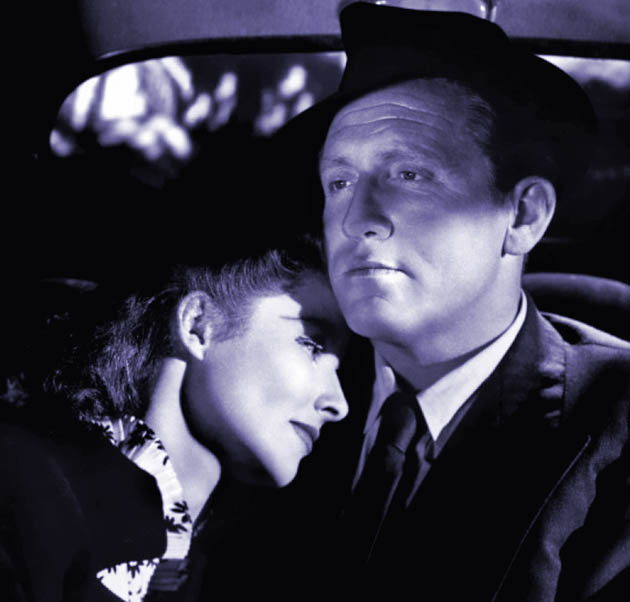
Katharine Hepburn in ‘Woman of the Year,’ with Spencer Tracy: Film career landmark was first pairing of what some call the ‘greatest Hollywood movie couple.’
First pairing with Spencer Tracy
Woman of the Year, for its part, was the third and final Hepburn film directed by George Stevens – following Alice Adams (1935) and Quality Street (1937). More importantly, it marked the beginning of the Katharine Hepburn–Spencer Tracy collaboration, which encompassed nine movies over the course of a quarter of a century.[3]
Indeed, some find the Hepburn-Tracy duo the greatest movie pairing this side of Lauren Bacall and Humphrey Bogart, and that side of Judy Garland and Mickey Rooney. Which says a lot.
Anyhow, for her efforts as a career-oriented woman who learns what true womanhood is all about, Hepburn received her fourth Best Actress Oscar nomination.
The Philadelphia Story, Woman of the Year
For the record: Katharine Hepburn lost the 1940 Best Actress Oscar to fellow 1930s RKO’er Ginger Rogers in Sam Wood’s Kitty Foyle, costarring Dennis Morgan. And she lost the 1942 Oscar to fellow MGM’er Greer Garson in William Wyler’s blockbuster Mrs. Miniver, also featuring Walter Pidgeon and Teresa Wright.
Also for the record: Donald Ogden Stewart and Hepburn-Grant costar James Stewart won Academy Awards for The Philadelphia Story. Stewart #1 won in the Best Screenplay category.[4] Stewart #2 was the surprise Best Actor winner.
Ring Lardner Jr. and Michael Kanin shared the 1942 Best Original Screenplay Oscar for Woman of the Year.
Anti-Red hysteria vs. Oscar winners
I should add that all three Oscar-winning screenwriters – Donald Ogden Stewart, Ring Lardner Jr., and Michael Kanin – would be blacklisted during the Red Scare.
Stewart’s film career would never recover. Kanin worked sporadically in the 1950s, eventually earning a second Academy Award nomination for the 1958 romantic comedy Teacher’s Pet, starring Doris Day and Clark Gable. (He shared the Oscar nod with his wife and future Academy of Motion Picture Arts and Sciences president Fay Kanin.)
One of the Hollywood Ten, Ring Lardner Jr. would come back with the 1965 Norman Jewison-directed drama The Cincinnati Kid, starring Steve McQueen and Edward G. Robinson. Lardner Jr. would win a second Oscar – this time in the Best Adapted Screenplay category – for the Robert Altman-directed, anti-military satire M*A*S*H (1970).
Bringing Up Baby, Quality Street
Among the 11 Katharine Hepburn star vehicles being shown on Turner Classic Movies, my favorite is Howard Hawks’ 1938 screwball comedy Bringing Up Baby, costarring Cary Grant. I’m just not sure how funny a movie can be after 18 viewings.
Admittedly, I’ve only seen Bringing Up Baby twice. Avid TCM’ers, however, have probably watched this one at least one or two dozen times. It seems to be on every week.
A less famous – but also frequently shown – Katharine Hepburn movie I’d recommend is the fairy-tale-ish, George Stevens-directed Quality Street (1937). Some care neither for the film nor for Hepburn’s performance. I find both, for lack of a better word, charming.
As a plus, Cora Witherspoon is great in this RKO release. And you’ll have the chance to check out Joan Fontaine at the very beginning of her career. (As an aside, Marion Davies starred in MGM’s 1927 silent version.)
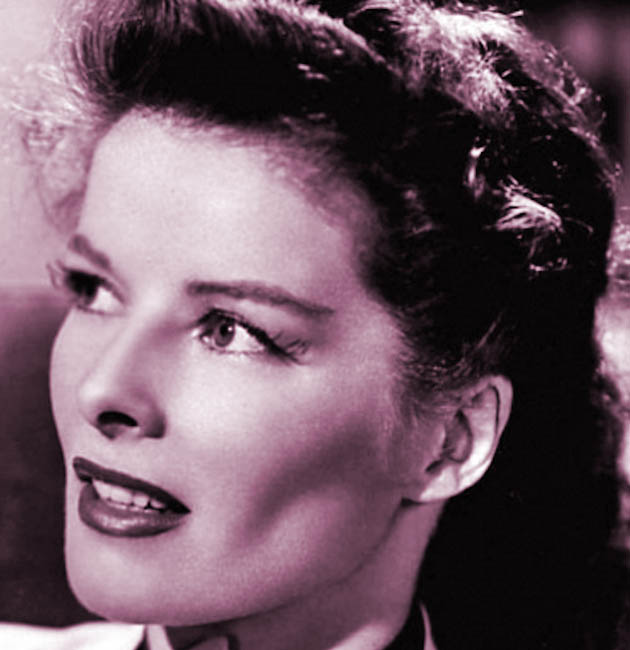
Katharine Hepburn: Four-time Best Actress Oscar winner in five-decade film career.
More Katharine Hepburn movies: In love with Dr. Frankenstein, to fight or not to fight fascism
The tale of a ruthless New Mexico cattle baron and a group of homesteaders feuding over the state’s grasslands – on whose side is the rancher’s wife? – Elia Kazan’s great-looking but heavy-handed The Sea of Grass (1947) is only for die-hard Katharine Hepburn fans.
But both Dorothy Arzner’s Christopher Strong (1933), John Cromwell’s Spitfire (1934), and George Cukor’s Keeper of the Flame (1942), however flawed, are all definitely worth a look.
It’s unclear whether or not Dorothy Arzner being a lesbian influenced her gender-bending take on Christopher Strong. Either way, it’s inescapably there. That in itself adds some welcome complexity to the tale of an aviatrix who falls for a married man (Dr. Frankenstein himself, Colin Clive).
In Keeper of the Flame, we get melodrama mixed with politics, as Hepburn, in the title role, ultimately realizes that Democracy (capital “D”) cannot exist without sociopolitical transparency. I don’t think anyone would argue against that – except, that is, those holding positions of power.
Yet, partly thanks to George Cukor’s old-school direction, Keeper of the Flame’s anti-fascist stance is pretty tame. Especially so when compared to something like Orson Welles’ Citizen Kane, released the year before.
Summertime: What’s in a name
More than a decade after Keeper of the Flame, Katharine Hepburn shone in Summertime (1955), which earned the actress and director David Lean Academy Award nominations. Veteran Isa Miranda, whose 1934 classic Everybody’s Woman / La signora di tutti reportedly inspired elements found in Citizen Kane, should have received a supporting nod as well.
In his autobiography, playwright/screenwriter Arthur Laurents (West Side Story, Gypsy) complains that Summertime, the film version of his 1952 Broadway play The Time of the Cuckoo, diluted the effectiveness of the story.
According to Laurents, a key issue was the casting of sleek Katharine Hepburn (instead of dowdy Shirley Booth) as “Jane Hudson” (instead of “Leona Samish”). He goes on to explain the importance of a character’s name for the audience’s perception of said character.
That’s all fine, but I’m glad the blatantly obvious Leona became the more generic Jane – who could be any lonely, middle-aged woman, American or otherwise. That way, you can see in the character what the actor conveys; not what the playwright wants to shove down your throat. I’m also glad that Hepburn got the chance to work wonders with the role.
Italian heartthrob Rossano Brazzi plays Jane’s love interest in Summertime. Dino Diluca was Leona’s near-paramour onstage.
Wrapping this up, TCM will also be showing David Heeley’s 1993 documentary Katharine Hepburn: All About Me. Hepburn’s tell-all-but-nothing autobiography is called Me: Stories of My Life. It was published in 1991.
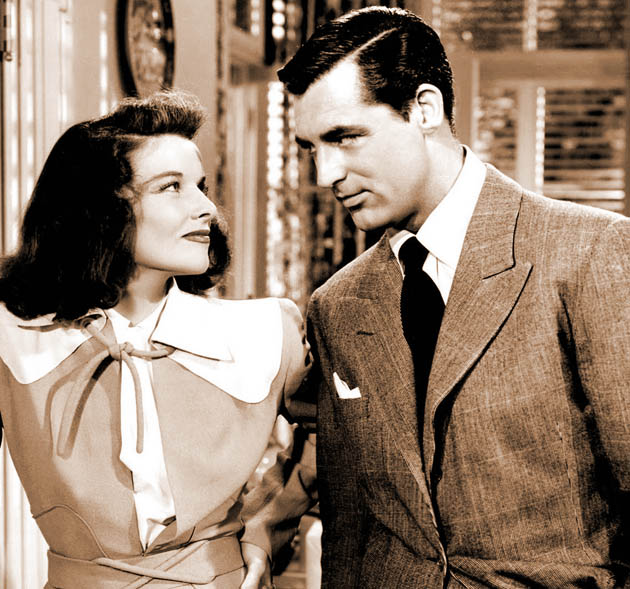 Katharine Hepburn in The Philadelphia Story, with Cary Grant: Film career landmark revived Hepburn’s moribund Hollywood stardom.
Katharine Hepburn films: TCM schedule (PT)
3:00 AM Spitfire (1934)
Cast: Katharine Hepburn, Robert Young, Ralph Bellamy, Sarah Haden, Will Geer.
Director: John Cromwell.
87m4:30 AM Christopher Strong (1933)
Director: Dorothy Arzner.
Cast: Katharine Hepburn, Colin Clive, Billie Burke, Helen Chandler, Ralph Forbes, Irene Browne, Jack La Rue, Margaret Lindsay, Donald Stuart.
78m6:00 AM Katharine Hepburn: All About Me (1993)
Director: David Heeley.
70m7:15 AM Mary of Scotland (1936)
Director: John Ford.
Cast: Katharine Hepburn, Fredric March, Florence Eldridge, Douglas Walton, John Carradine, Robert Barrat, Gavin Muir, Ian Keith, Moroni Olsen, Ralph Forbes, Alan Mowbray, Frieda Inescort, Donald Crisp, David Torrence, Molly Lamont.
123m9:30 AM Quality Street (1937)
Director: George Stevens.
Cast: Katharine Hepburn, Franchot Tone, Fay Bainter, Cora Witherspoon, Joan Fontaine.
83m11:00 AM Undercurrent (1946)
Director: Vincente Minnelli.
Cast: Katharine Hepburn, Robert Taylor, Robert Mitchum.
116m1:00 PM The Sea of Grass (1947)
Director: Elia Kazan.
Cast: Spencer Tracy, Katharine Hepburn, Melvyn Douglas, Robert Walker, Phyllis Thaxter, Edgar Buchanan, Harry Carey, Ruth Nelson, William ‘Bill’ Phillips, Robert Armstrong, James Bell, Robert Barrat.
124m3:15 PM Keeper of the Flame (1942)
Director: George Cukor.
Cast: Spencer Tracy, Katharine Hepburn, Richard Whorf, Margaret Wycherly, Forrest Tucker, Frank Craven, Stephen McNally, Percy Kilbride, Audrey Christie, Darryl Hickman, Donald Meek, Howard Da Silva.
101m5:00 PM Woman of the Year (1942)
Director: George Stevens.
Cast: Spencer Tracy, Katharine Hepburn, Fay Bainter, Reginald Owen, Minor Watson, William Bendix, Gladys Blake, Dan Tobin, Roscoe Karns.
112m7:00 PM Without Love (1945)
Director: Harold S. Bucquet.
Cast: Spencer Tracy, Katharine Hepburn, Lucille Ball, Keenan Wynn, Carl Esmond, Patricia Morison, Felix Bressart.
111m9:00 PM Bringing Up Baby (1938)
Director: Howard Hawks.
Cast: Katharine Hepburn, Cary Grant, Charles Ruggles, May Robson, Walter Catlett, Barry Fitzgerald, Fritz Feld, Tala Birell, Jack Carson.
102m11:00 PM The Philadelphia Story (1940)
Director: George Cukor.
Cast: Katharine Hepburn, Cary Grant, James Stewart, Ruth Hussey, John Howard, Roland Young, John Halliday, Mary Nash, Virginia Weidler, Henry Daniell, Hillary Brooke.
112m1:00 AM Summertime (1955)
Director: David Lean.
Cast: Katharine Hepburn, Rossano Brazzi, Isa Miranda, Darren McGavin, Mari Aldon, Jane Rose, MacDonald Parke, Jeremy Spenser, Gaetano Autiero, André Morell.
100m
notes
Garson Kanin
[1] Woman of the Year co-writer Michael Kanin was the brother of sometime Katharine Hepburn collaborator Garson Kanin. With wife Ruth Gordon, Garson Kanin wrote the Hepburn-Tracy star vehicles Adam’s Rib (1949) and Pat and Mike (1952).
Garson Kanin also penned Tracy and Hepburn: An Intimate Memoir, in which he discussed his friendship with the two stars. The book reportedly led to a falling out between Kanin and Hepburn. (Tracy had been dead for a few years.)
Best Actress Oscar wins
[2] Katharine Hepburn’s first two Best Actress Academy Award nominations were for Lowell Sherman’s Morning Glory (1932–1933) and George Stevens’ Alice Adams (1935). She won for the former. The second time around she lost to Bette Davis in Dangerous.
Hepburn’s three other Best Actress Oscar wins were for Stanley Kramer’s Guess Who’s Coming to Dinner (1967), Anthony Harvey’s The Lion in Winter (1968, tied with Barbra Streisand in William Wyler’s Funny Girl), and Mark Rydell’s On Golden Pond (1981).
Katharine Hepburn-Spencer Tracy movies
[3] The Katharine Hepburn-Spencer Tracy movies were the following:
- George Stevens’ Woman of the Year (1942)
- George Cukor’s Keeper of the Flame (1942)
- Harold S. Bucquet’s Without Love (1945)
- Elia Kazan’s The Sea of Grass (1947)
- Frank Capra’s State of the Union (1948)
- George Cukor’s Adam’s Rib (1949)
- George Cukor’s Pat and Mike (1952)
- Walter Lang’s Desk Set (1957)
- Stanley Kramer’s Guess Who’s Coming to Dinner (1967)
Besides Woman of the Year, Turner Classic Movies will be showing three other Hepburn-Tracy titles: Keeper of the Flame, Without Love, and The Sea of Grass, all of which were MGM productions.
Of the above, the only non-MGM releases were Desk Set (20th Century Fox) and Guess Who’s Coming to Dinner (Columbia).
Best Writing Oscar categories
[4] For several decades, the Academy Awards had three Best Writing categories. Category labels changed throughout the years; in 1940, they were Best Original Story, Best Original Screenplay, and Best Screenplay.
The 1940 winners were, respectively, Benjamin Glazer and Hans Székely for Arise My Love (1940), Preston Sturges for The Great McGinty, and, as mentioned earlier in the text, Donald Ogden Stewart for The Philadelphia Story.
Katharine Hepburn movies’ cast information via the IMDb.
Katharine Hepburn movies’ schedule via the Turner Classic Movies website.
Cary Grant and Katharine Hepburn The Philadelphia Story image: Metro-Goldwyn-Mayer.
Spencer Tracy and Katharine Hepburn Woman of the Year image: MGM.