
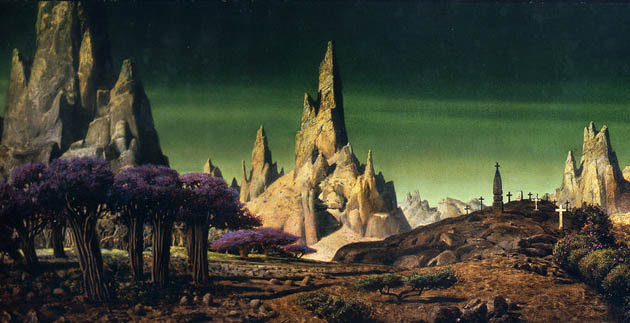
 Forbidden Planet matte painting.

‘The Magic and Mystery of Movie Matte Painting’ to explore cinema’s pre-CGI ‘virtual sets’
This December 2007, the Academy of Motion Picture Arts and Sciences’ Science and Technology Council will be presenting “Fantastic Reality: The Magic and Mystery of Movie Matte Painting,” on Monday, Dec. 10, at 8 p.m. at the Linwood Dunn Theater in Hollywood. Oscar nominee and Academy Visual Effects Branch governor Craig Barron (Batman Returns, 1993) will host the evening.
According to the Academy’s press release, “The Magic and Mystery of Movie Matte Painting”
“will explore the long history of the traditional method of creating ‘virtual sets,’ in which oil paints are brushed and daubed onto a few square feet of glass or wood to be composited later with live action footage. The recent transition into the new frontiers of software and pixels will also be examined.”
‘Playing God: The Art and Artists of Matte Painting’
In conjunction with “The Magic and Mystery of Movie Matte Painting,” the Academy will open the new exhibition “Playing God: The Art and Artists of Matte Painting” in the foyer of the Linwood Dunn Theater.
The exhibition will profile the lives and works of Peter Ellenshaw (20,000 Leagues Under the Sea), Albert Whitlock (The Man Who Would Be King), Matthew Yuricich (Ghostbusters), and others, with displays of their “tools of the trade,” including several of the matte paintings created for such films as Victor Fleming’s The Wizard of Oz (1939), Fred M. Wilcox’s Forbidden Planet (1956), Stanley Kubrick’s Spartacus (1960), and Alfred Hitchcock’s The Birds (1963).
Tickets to “Fantastic Reality” are $5 for the general public and $3 for Academy members and students with a valid ID. “Playing God: The Art and Artists of Matte Painting” is open during Academy events at the Dunn Theater only. Admission is free. The Linwood Dunn Theater is located at 1313 Vine Street in Hollywood. For additional information, visit www.oscars.org or call (310) 247-3600.

Robert Mitchum interviews available on Roger Ebert website
U.S. film critic Roger Ebert affirms that Robert Mitchum, best remembered for a series of films noir and thrillers from the 1940s and 1950s, was both his favorite movie star and favorite interview subject.
“He would tell you anything,” Ebert explains. “He fearlessly maligned his directors, costars, even actors he had never worked with. ([Steve] McQueen? ‘He doesn’t bring much to the party.’) He was once called ‘the embodiment of film noir,’ and that was about right.”
On his website’s “From the Archives” segment, Ebert has posted four of the interviews he conducted with Mitchum, three of held around the time he was starring in David Lean’s Ryan’s Daughter (1970), and the fourth a tribute that came out about two decades later.
“You get a sense of his irreverence,” Ebert notes, “his refusal to take himself seriously, and also, beneath the surface, a constant intelligence. Nobody can be that funny and not know what he is doing.”
Robert Mitchum vs. Steve Cochran
Unlike most Old Hollywood fans, in this movie watcher’s view Robert Mitchum is hardly at his most memorable as a film noir antihero.
Jacques Tourneur’s mind-boggling Out of the Past is an intriguing entry in the genre, but chiefly because of femme fatale Jane Greer. Angel Face is all about Jean Simmons, while Crossfire is basically a Robert Ryan showcase. When it comes to The Locket and The Racket, Laraine Day and Lizabeth Scott are, respectively, the performers that comes to mind.
Heresy, perhaps, but I believe that Steve Cochran (White Heat, Il Grido) would have been much more effective in any of Mitchum’s noir roles. Cochran was more handsome, more brooding, more sensual, more menacing, and, at least on screen, a more convincing ladies’ man.
Besides, the sameness of Mitchum’s somnolent approach to acting is detrimental to many of his movies.
At his best when cast against type
There are, however, a few glaring exceptions – invariably when film noir’s cynical, tough guy was cast against type.
Poor accent or no, he is quite good as an affable and somewhat “weak” sheepman in Fred Zinnemann’s Australian outback-set The Sundowners (1960), in which he is paired with the even more eminently watchable Deborah Kerr, also cast against type as his wife and fellow hick.
Mitchum is also memorable in another non-virile role: the schoolmaster and cuckolded husband in Ryan’s Daughter. This may well be his finest performance, even though David Lean’s uneven, Irish-set romantic/political drama actually belongs to eventual Best Actress Oscar nominee Sarah Miles as the schoolmaster’s adulterous wife.
Robert Mitchum quotes
As for his interviews, Robert Mitchum could indeed sound unabashedly caustic when discussing other people he knew and/or had worked with. Entertaining reading (or watching) for some, perhaps, but a number of his harsher, crueler remarks place him in a less flattering light than the people he is putting down.
Here’s a longish – and, all things considered, inoffensive – Robert Mitchum quote from an interview Roger Ebert conducted in October 1969. Mentioned are filmmakers Robert Parrish and Robert Wise, and actress Shirley MacLaine.
“But I don’t give a damn, I must be good at my job; they wouldn’t haul me around the world at these prices if I weren’t. I remember one picture – [The] Wonderful Country [1959], I think it was – where the character comes across the border from Mexico. Parrish was the director and he wanted me to gradually lose my Mexican accent and then pick it up again when I went back to Mexico.
“Parrish is essentially a cutter, not a director. There are several of those. Wise, for example, couldn’t find his way out of a field without a choreographer. Bobby even times a kiss with a stopwatch. He marks out the floor at seven o’clock in the morning, before anybody gets there. Lays it all out with a tape measure. True. It’s very difficult to work that way. I worked with him and Shirley MacLaine [on Two for the Seesaw, 1962] and Shirley said, ‘Why doesn’t he go home? He’s just in the way…’ ”
In this same 1969 interview, you get the full Robert Mitchum quote regarding Steve McQueen:
“I never saw [Robert Wise’s 1966 Best Picture Oscar nominee] The Sand Pebbles. Of course that was a problem picture out in front, with [Best Actor Oscar nominee] Steve McQueen in it. You’ve got to realize a Steve McQueen performance just naturally lends itself to monotony. Steve doesn’t bring too much to the party.”
‘The Night of the Hunter’: James Agee & Stanley Cortez
[1] Based on David Grubb’s 1953 novel, The Night of the Hunter was adapted by The Nation and Time film critic-turned-screenwriter James Agee, with rewrites by director Charles Laughton. A chronic alcoholic and heavy smoker, Agee suffered a fatal heart attack at age 45 in the year The Night of the Hunter came out.
Besides Robert Mitchum and Shelley Winters, The Night of the Hunter’s other notable cast member is silent era veteran Lillian Gish (The Birth of a Nation, Broken Blossoms, The Scarlet Letter), in what is probably her most effective talkie role.
The thriller was beautifully shot by two-time Oscar-nominated cinematographer Stanley Cortez (The Magnificent Ambersons, 1942; Since You Went Away, with Lee Garmes, 1944), brother of silent era/Pre-Code leading man Ricardo Cortez.
Unfortunately, The Night of the Hunter turned out to be Laughton’s sole directorial foray.
Forbidden Planet matte painting image: Courtesy of Craig Barron.
Robert Mitchum The Night of the Hunter image: United Artists.
“Matte Painting Techniques + Robert Mitchum Interviews Dissing Steve McQueen & Robert Wise” last modified in April 2018.