
The Weinstein Company’s Meryl Streep Oscar ad ‘controversy’

According to TheWrap’s Steve Pond, the email “stirred up anger among Academy members and rival campaigners,” as it looked like TWC was in one fell swoop breaking Academy rules barring email campaigns extolling “the merits of a film, an achievement or an individual,” referencing past awards, or containing links to websites plugging an eligible film.
However, an Academy loophole allows such emails to be sent by third parties – something that, as can be attested, makes the rules themselves worthless.

The Weinstein Company COO David Glasser later complained to TheWrap that “not only are the Variety and Hollywood Reporter campaigns legal from an Academy standpoint, but they will be used by a number of different studios in the days ahead. It seems that every time TWC is innovative there is always some jealous competitor who … comes out of the woodwork.”
Now, there’s nothing “innovative” about the ad itself, tugging at the heartstrings of Academy members. That sort of approach has been around for decades. Something else that’s not at all new is that eyebrows were raised at a Harvey Weinstein company’s Oscar campaign strategy. That has been happening for quite some time. In fact, back in 2003 Oscar campaign rules were changed following Miramax’s ad – containing an endorsement by former Academy president and two-time Oscar winner Robert Wise – pushing for a Best Director Oscar for Gangs of New York’s Martin Scorsese.
Rio, The Muppets songs not to be performed at Oscar ceremony
Even though there are only two Best Original Song nominees for the 2012 Academy Awards, according to Deadline.com, Rio’s “Real in Rio” (music by Sergio Mendes and Carlinhos Brown, lyric by Siedah Garrett) and The Muppets’ “Man or Muppet” (music and lyric by Bret McKenzie) will not be performed at the upcoming Oscar ceremony. Time constraints would seem to be the reason for the decision – which hasn’t been set in stone.
Deadline posted bits from an email from an “authoritative source,” explaining that “The show is not locked yet. Decisions about this and other things continue to be evaluated by the team trying to produce the most entertaining 3 hours possible. Someone ‘leaking’ this possibility to you is just another way for people to try and influence the creative direction of the show. And there have been Oscar shows that did not have the nom songs performed.” (At the 2010 ceremony, for instance, the nominated songs were shown in clips.)
Brian Grazer, who replaced Brett Ratner following the gay slur-Lindsay Lohan brouhaha, and Don Mischer are the 2012 Oscar ceremony producers.
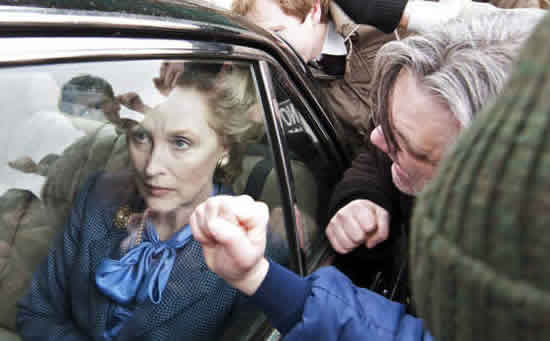
Meryl Streep as Margaret Thatcher, The Iron Lady
Oscar Predictions: Meryl Streep
This year, Meryl Streep will be receiving her 17th Oscar nomination – 14th as Best Actress. Her previous nods were for the following:
Best Supporting Actress:
- Michael Cimino’s The Deer Hunter (1978)
- Robert Benton’s Kramer vs. Kramer (1979)
- Spike Jonze’s Adaptation (2002)
Best Actress:
- Karel Reisz’s The French Lieutenant’s Woman (1981)
- Alan J. Pakula’s Sophie’s Choice (1982)
- Mike Nichols’ Silkwood (1983)
- Sydney Pollack’s Out of Africa (1985)
- Hector Babenco’s Ironweed (1987)
- Fred Schepisi’s A Cry in the Dark (1988)
- Mike Nichols’ Postcards from the Edge (1990)
- Clint Eastwood’s The Bridges of Madison County (1995)
- Carl Franklin’s One True Thing (1998)
- Wes Craven’s Music of the Heart (1999)
- David Frankel’s The Devil Wears Prada (2006)
- John Patrick Shanley’s Doubt (2008)
- Nora Ephron’s Julie & Julia (2009)
Streep won for Kramer vs. Kramer and Sophie’s Choice. She has been nominated 12 times since.
Oscar Predictions Best Supporting Actress: Octavia Spencer & Jessica Chastain
There’ll be anywhere between five and ten Best Picture nominees this year, depending on how many movies manage to get at least 5 percent of first-place votes*. That variable must be taken into consideration, whether you find that it increases the suspense (and therefore is a good thing) or decreases the chances of truly small movies getting a nomination (and therefore is a really bad thing).
This late in the game, only five movies are shoo-ins for a Best Picture nod: Michel Hazanavicius’ The Artist (The Weinstein Company), Martin Scorsese’s Hugo (Paramount), Alexander Payne’s The Descendants (20th Century Fox), Woody Allen’s Midnight in Paris (Sony Pictures Classics), and Tate Taylor’s The Help (Walt Disney Studios).
Even more curious is that – despite a SAG Award nomination for Best Cast – there’s a Woody Allen movie in the running without a single likely Oscar nomination in the acting categories. (Midnight in Paris’ Owen Wilson and Marion Cotillard are longshots.) To date, Allen has directed no less than 16 Oscar-nominated performances, including six winners (Diane Keaton for Annie Hall, Dianne Wiest for Hannah and Her Sisters and Bullets Over Broadway, Michael Caine for Hannah and Her Sisters, Mira Sorvino for Mighty Aphrodite, and Penélope Cruz for Vicky Cristina Barcelona).
* After some spreading around of “surplus” votes and “orphan” votes. The surplus is triggered after a movie is the top choice in more than 1/11th + 1 of the ballots (the minimum number of topmost votes required for a maximum of ten nominees). The surplus votes (now worth less than one full vote) are then redistributed to the second or third or fourth choice on each surplus ballot, depending on which movies haven’t already been shortlisted as official nominees. Additionally, ballots topped by films that received less than 1 percent of the votes will also be redistributed.

But what about the NC-17 “stigma” re: Michael Fassbender for Shame? Even if you choose to ignore Marlon Brando’s Best Actor nomination for Bernardo Bertolucci’s Last Tango in Paris back in the early 1970s, Michelle Williams was a Best Actress nominee last year despite the initial NC-17 (later toned down to an “R”) rating given to Derek Cianfrance’s Blue Valentine. True, Blue Valentine was plugged by the Oscar-savvy The Weinstein Company, but Shame’s Fox Searchlight is no slouch when it comes to pushing potential Oscar nominees, e.g., Danny Boyle’s 127 Hours, Darren Aronofsky’s Black Swan.
Now, how could North American critics’ fave Jessica Chastain not be a shoo-in? Well, Chastain is a near shoo-in. Though not a strong probability, it’s certainly possible that she won’t get enough first/second place votes for either The Help or Terrence Malick’s The Tree of Life. And it could get even worse: Chastain fans could choose to vote for her performances in, say, Take Shelter or Coriolanus. In fact, that’s the one instance – one actor with multiple well-received roles in a single year – when “splitting the votes” to the detriment of a potential front-runner is an actual possibility.
In 1946, for instance, Olivia de Havilland asked Universal to not push her for Robert Sidomak’s thriller The Dark Mirror, as Paramount was already campaigning for her performance as a long-suffering single mother in Mitchell Leisen’s melodrama To Each His Own. De Havilland not only got nominated for To Each His Own, she went on to win that year’s Best Actress Oscar. Forty years later, Julie Andrews was in the running for two movies: Blake Edwards’ dramatic comedy That’s Life and Andrei Konchalovsky’s drama Duet for One. Quite possibly due to vote-splitting (competition in the Best Actress category was hardly fierce that year), Andrews failed to be shortlisted.
Now, despite our misgivings, we believe that Chastain will be shortlisted for The Help because of both the film’s popularity and Chastain’s SAG Award nomination.
Surprisingly, the only Best Supporting Actor shoo-in this late in the game is veteran Christopher Plummer (The Sound of Music) for playing Ewan McGregor’s gay father in Mike Mills’ Beginners. Plummer has already won a Golden Globe, a series of critics’ awards, and is up for a SAG Award.
Following a whole slew of North American critics’ awards, Albert Brooks should have been a shoo-in as well for his gangster in Nicolas Winding Refn’s thriller Drive. Brooks, however, has been left out of both the SAG Awards and the British Academy Awards. In other words, his Oscar nomination has become less of a sure thing.
The third slot goes to SAG Award and BAFTA nominee Kenneth Branagh for playing Laurence Olivier opposite Michelle Williams’ Marilyn Monroe in Simon Curtis’ My Week with Marilyn. That would be Branagh’s first Academy Award nomination in the acting categories since Henry V (1989), which he also directed – and got nominated for his efforts behind the camera, too. (Curiously, Olivier also directed and starred in a 1946 version of Henry V that earned him a Best Actor Oscar nod.)
Asghar Farhadi’s A Separation, no matter how brilliant, will land a Best Picture nod only if Farhadi himself lands a Best Director nod. Our point: Don’t expect that to happen.
Barring a miracle, Stephen Daldry’s string of Oscar nominations – Billy Eliot, The Hours, The Reader; one for each of his feature films – will be broken when Extremely Loud and Incredibly Close is left out of the running in the Best Director category.
The 2012 Academy Award nominations will be announced on Jan. 24. At 8:30 a.m. EST/5:30 a.m. PST Academy President Tom Sherak and 2011 Best Actress nominee Jennifer Lawrence (Winter’s Bone’s) will announce the nominees in a handful of categories.
notes
Meryl Streep The Iron Lady image: The Weinstein Company.
Demián Bichir A Better Life image: Summit Entertainment.