
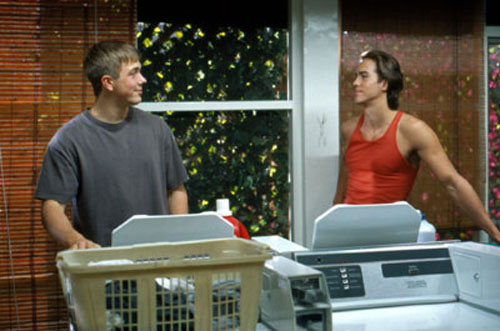
 Californians will be voting on Proposition 8 this coming Tuesday. Considering how religious beliefs are the engine behind the anti-gay marriage proposition, and that according to numerous reports the Mormon Church has been fighting the fight to make sure that gays and lesbians never have their unions recognized by the state, I thought it only appropriate to post a clip from the 2003 romantic dramatic comedy Latter Days, which stars Steve Sandvoss as a Mormon missionary who – sit tight – is seduced and corrupted by the vile gay lifestyle.

Well, at least that’s how his Mormon family sees the young man’s coming out of the closet. Writer-director C. Jay Cox, a gay man who was himself a former Mormon missionary, clearly has a very different view.
About three minutes into the clip above, the young missionary, Elder Aaron Davis, is tried by Mormon Church elders, among whom is his own father.
“Dad, your grandfather had half a dozen wives,” Elder Aaron says in his defense. “The same goes for every single person in this room. I’d say we [Mormons] were the original definition of alternative lifestyle.”
“Are you calling us hypocrites?” his father asks him.
“No, we’ve gone way beyond hypocrisy, dad,” Elder Aaron replies. “Now we’re just being mean.”
Needless to say, Elder Aaron will have been demoted to just Plain Aaron before the trial is over. If that weren’t all, Aaron is then confronted by his pious mother, who tells him how “repulsive” his homosexual feelings are.
I recall reading several reviews after I watched Latter Days on DVD last year. Curiously, some reviewers bitterly complained that the film had a biased, anti-Mormon stance, as Latter Days portrays conservative Mormons as blatant anti-gay bigots. Considering that according to some estimates about 40 percent of the money for the Yes on 8 campaign came from Mormons, it’s obvious that those reviewers weren’t very well informed about the Mormon Church’s stance on homosexuality – in all fairness, a stance that is quite similar to that of many other Christian denominations and of other religions as well – and how said stance is accepted and abided by unquestioning, well-intentioned People of Faith with a good heart.
Now, with well-intentioned, good-hearted people like those – people (Mormons or otherwise) who love and care about you so much they’d spend lots of time and effort, in addition to millions of dollars to discriminate against you – who the hell needs vicious enemies? In truth, the people – no matter their religion or lack thereof – with real good intentions and real good hearts are the ones (including a number of Mormons) fighting to ensure fairness and equal rights for all.
“Californians must cast a clear eye on Proposition 8’s real intentions,” reads the final paragraph of the Los Angeles Times’ November 2 editorial. “It seeks to change the state Constitution in a rare and terrible way, to impose a single moral belief on everyone and to deprive a targeted group of people of civil rights that are now guaranteed. This is something that no Californian, of any religious belief, should accept. Vote no to the bigotry of Proposition 8.”
Also in the Latter Days cast: Wes Ramsey (as the outrageously swishy type who – absurdly – wins the Mormon guy’s heart), Rebekah Johnson, Amber Benson, Jacqueline Bisset, Khary Payton, Joseph Gordon-Levitt, Erik Palladino, Rob McElhenney, Dave Power, and – delivering the film’s best performance – Mary Kay Place as a Mormon Mom who, before the film is over, begins to see the light of compassion, tolerance, and good ol’ ethical behavior.
‘Milk’ & Prop. 8 + More Celebrity Gay Slurs
I doubt that Milk itself would have had any impact on the Prop. 8 vote. That said, I believe that if an early Milk release had been surrounded by loads of publicity, at least some voters would have understood that just like California didn’t go under after the anti-gay Prop. 6 was defeated back in 1978 it wouldn’t go under if the anti-gay Prop. 8 got defeated as well.
In fact, I can’t understand why Focus Features, which is releasing Milk on November 26, didn’t open the film in September or October, when the Prop. 8 debate became quite heated not only in California but elsewhere in the United States as well. That would have meant lots of free publicity for their film, which they hope will be a contender for the 2009 Academy Awards.
And sticking to the anti-gay subject of this post, here’s wondering if Mickey Rourke’s chances for an Oscar for his performance as a has-been professional wrestler in The Wrestler would have gone up in smoke had he used a, say, black or Jewish slur instead of a gay one while being pursued by paparazzi in the dark streets of Los Angeles. In this video, Rourke can be clearly heard saying, “And tell that faggot [apparently the Perez Hilton guy] who said all that shit in the paper [about his The Wrestler costar Evan Rachel Wood] I’d like to break his fucking legs.”
And you’d thought that the whole circus surrounding Isaiah Washington & gay slurs would have had much of an effect on the way celebrities (publicly) referred to gay people, huh?
Sundance: To Boycott or Not to Boycott
David Poland at Movie City News:
“Movie City News will spend a lot of money in Park City to cover Sundance this year. I will be happy to pledge, right now, that we will not spend a dime that money in businesses that were financial supporters of California’s Prop 8.
“So… activists… make that list. Make it honestly. Don’t tell me all Mormons are evil or that the entire state is off limits. But if a local gas station company is owned by a Prop 8 funder… we will fill up elsewhere. If a local restaurant or grocery or ski shop or taxi service… anything like that… if the owner sent money to California to strip gay Californians of their rights… I will be honored to not support that person with my business and to be as loud as I can about making that choice.”
***
Via indieWIRE:
“‘Boycott Sundance because Mormons live in Utah?’ asked filmmaker Allison Anders today, responding via Facebook, ‘How absurd – I am showing my students Safe today by Todd Haynes and in my lecture will talk about how groundbreaking it was that Poison was at the festival even before the “Class of ’92” – and in that class of ’92 was included in the competition of 12, Greg Araki’s film The Long Weekend (O’ Despair) (one of the earliest indies to deal with AIDS) , and Tom Kalin’s Swoon. Sundance was for decades one of the tiny few hands that fed gay filmmakers, women filmmakers, browns, blacks, reds and everyone underrepresented on the screen, and it continues to be that for all of us. If people continue to misplace their rage over Prop 8 passing, they will change not one thing and none of us who supported the No on Prop 8 vote wants to see that happen.'”
***
Mario Ruiz in The Huffington Post:
“Gay people are fed up and have learned a thing or two about mobilizing themselves – and not just for angry rallies. Some pro-Proposition 8 folks may come to regret their not so private support of hate. And were you thinking about skiing in Utah this year? Hmmm, Colorado’s looking pretty appealing these days.”
***
It’s funny that Ruiz mentions Colorado as a “pretty appealing” place. Not that long ago – well, in the early 1990s – Barbra Streisand was suggesting a boycott of the state following passage of anti-gay legislation.
“There are plenty of us who love the mountains and rivers of that beautiful state,” Streisand told the crowd at an AIDS Project Los Angeles benefit in 1992, “but we must now say clearly that the moral climate there is no longer acceptable, and if we’re asked to, we must refuse to play where they discriminate.”
Streisand ended up taking quite a bit of flak for her stance because cities such as Denver, Aspen, and Boulder are “liberal” – or at least what passes for liberal in most people’s heads – and they would suffer from a tourism boycott as much as (or rather, more than) towns and counties ruled by anti-gay right-wing Christians whom no one wanted to go visit anyway. (The anti-gay law, named Amendment 2, was later declared unconstitutional.)
Curiously, I learned about the suggested boycott of all things Utah because of that state’s large Mormon population just this morning, shortly after deleting a comment on our Latter Days (above, with Steve Sandvoss and Wes Ramsey) post of a few days ago. In the comment, the author berated us for stating that gays were being discriminated by supporters of the anti-gay marriage Proposition 8 (especially the Mormon Church), while asserting that society would go under if gay people gained the right to marry one another. Even more rationally, the writer compared the legalization of same-sex marriages to the legal recognition of bestiality and child molestation.
I don’t know if the person who sent the aforementioned comment is a Mormon. But I do know that anti-Mormon bigotry is just as unethical as anti-gay bigotry or bigotry of any kind. In fact, there were many Mormons who fought against Prop. 8; and to boycott Sundance – as “liberal” a festival as can be – and the whole state of Utah would harm lots of people who believe in equal rights for all and/or who had absolutely nothing to do with the passing of Prop. 8.
On the other hand, Sundance organizers should allay festivalgoers’ concerns in regard to who’ll benefit economically from the eleven-day party. Those who supported Prop. 8 – regardless of their religion, if any – should not be included among the beneficiaries of the financial windfall that will blow into Park City come next January.
See also a The Advocate article on the possibility of pushing forward pro-gay rights legislation in Utah.
Threatened Sundance boycott
Jay Hamburger reports in The Park Record:
“Mayor Dana Williams acknowledges he is “certainly concerned” with the prospects of a boycott of Utah by gays and their allies, saying Park City could suffer even though the city had little to do with the gay-marriage ballot measure in California.
“Park City has a tradition of acceptance of gays, he says, but the city could be swept up in a movement by gays against Utah based on Proposition 8. Williams says gays are welcome in Park City.”
…
“It’s too bad that we could potentially take the brunt of an issue we didn’t participate in,” Williams says, adding he is worried about the effects on the ski season and the Sundance Film Festival.”
…
“A festival official recently told The Park Record Sundance has received phone calls and emails from people wanting the festival to abandon the Holiday Village screening rooms. The people tie Cinemark Theaters to the ballot measure. Sundance plans to continue showing films at Holiday Village.”
Hamburger adds that “the Mormon influence in Park City through the city’s history has been limited compared to the role the church has played in other Utah communities” because Park City was founded by silver miners, and the region’s mines attracted workers from various parts of the world. More recently, Californians, New Yorkers, and others have been moving into the area.

Joseph Julian Soria in Tru Loved.
Roger Ebert Laments the ‘Death’ of Film Critics
“A newspaper film critic is like a canary in a coal mine. When one croaks, get the hell out,” writes Roger Ebert in the November 2008 essay “Death to film critics! Hail to the CelebCult!” in the Chicago Sun-Times. “The lengthening toll of former film critics acts as a poster child for the self-destruction of American newspapers, which once hoped to be more like the New York Times and now yearn to become more like the National Enquirer. We used to be the town crier. Now we are the neighborhood gossip.” Ebert then adds:
The crowning blow came this week when the once-magisterial Associated Press imposed a 500-word limit on all of its entertainment writers. The 500-word limit applies to reviews, interviews, news stories, trend pieces and ‘thinkers.’ Oh, it can be done. But with Synecdoche, New York?
Worse, the AP wants its writers on the entertainment beat to focus more on the kind of brief celebrity items its clients apparently hunger for. The AP, long considered obligatory to the task of running a North American newspaper, has been hit with some cancellations lately, and no doubt has been informed what its customers want: Affairs, divorces, addiction, disease, success, failure, death watches, tirades, arrests, hissy fits, scandals, who has been ‘seen with’ somebody, who has been ‘spotted with’ somebody, and ‘top ten’ lists of the above. (Celebs ‘seen with’ desire to be seen, celebs ‘spotted with’ do not desire to be seen.)
Roger Ebert’s own media controversy: ‘Tru Loved’ review
Ironically, Roger Ebert, a writer I usually enjoy reading even if I hardly ever agree with his cinematic likes and dislikes, has always been criticized for schmoozing with assorted film personalities whose work he is supposed to impartially critique and for helping to popularize dumbed-down film criticism with the “two thumbs up” nonsense of his former television show with Gene Siskel.
More recently, Ebert became embroiled in an ugly controversy after writing a (scathing) review of Stewart Wade’s gay teen comedy-drama Tru Loved – despite having left the screening only eight minutes into the film. At the time, Entertainment Weekly’s PopWatch blog writer Gary Susman remarked:
“No other movie critic in America could have pulled off such a stunt without getting fired. I fear that, even though he corrected his mistake, he’s still set a bad example. At a time when film critics all over America are losing their jobs, it can’t be good for readers, editors, or filmmakers to think that what he did passes for professional, acceptable behavior among film critics and the outlets that publish their work, even for a moment.”
Celeb News: Is that something new?
As for Roger Ebert’s essay on the demise of print U.S. film critics, although I don’t disagree with what he has to say I believe that…
- Ebert simplifies things quite a bit, e.g., the media’s – and the public’s – obsession with celebrity gossip has been around for as long as celebrities have been around. Just think of the complicity of the American press in the “scandalous” Roscoe Arbuckle trial way back in 1921, or the Elizabeth Taylor and Richard Burton media circus of the 1960s.
- He ignores the role of the Internet in the downsizing of newspapers, and he should have mentioned that online you can find quite a bit of thoughtful and thought-provoking film commentary.
- He ignores the fact that the vast majority of movies shown on American screens are geared to mentally impaired pre-adolescents who can’t read sentences with more than three words in them; i.e., generally speaking, audiences that can’t – and don’t – read either movie reviews or newspapers.
- He fails to mention the fact that people today – as always – have never really cared about “serious” news, film-related or otherwise, unless the news is “entertaining” (for instance, war depicted as lots of pretty bright lights in the sky) or the subject in question either affects them or may come to affect them personally. Here’s one example: nearly 15 years ago, the genocide in Rwanda went underreported in the world media – there were no pretty bright lights in the sky; just people being hacked to death in a very small and very poor country – and that’s the way it’s been for as long as there have been news sources anywhere in the world.
Now, one thing I couldn’t figure out is why Roger Ebert is so shocked by the decline and fall of The Associated Press. That organization – which some refer to as “The Associated Trash” – has much too frequently been a purveyor of biased and dishonest (or merely superficial and inane) reporting for a very, very long time.
Joseph Julian Soria Tru Loved image: Regent Releasing.
gay-marriage-legal-utah-lesbian-movie
gay-marriage-legal-utah