
 Mainstream – “at best, mainstreamish” – critics group picks: Lisa Cholodenko’s audience-friendly The Kids Are All Right topped three New York Film Critics Circle award categories, including Best Actress honors for Annette Bening, admittedly outstanding as a lesbian wife and mother fighting to maintain the unity of her – more than a tad dysfunctional – family. In addition, The Kids Are All Right won NYFCC Awards for Best Screenplay (Cholodenko and Stuart Blumberg) and Best Supporting Actor for Mark Ruffalo, who plays a home-breaking heterosexual slob.

New York Film Critics Awards 2010: Mainstream winners, as U.S.-made (or -backed) crowd-pleasing fare top most categories
The New York Film Critics Circle have chosen their 2010 winners, which were announced on Dec. 12. Our predictions were mostly way off the mark (see further below), as the New York movie scribes, handing out awards since 1935, have mostly gone for mainstream – at best, mainstreamish – U.S.-made/backed fare.
The winners, whose quality varies from outstanding to mediocre, include the following:
- David Fincher’s box office hit The Social Network for Best Film and Best Director.
- Best Actor Colin Firth for Tom Hooper’s British-made, The Weinstein Company-backed The King’s Speech, a crowd-pleasing sleeper-hit-in-the-making.
- Best Actress Annette Bening for Lisa Cholodenko’s equally crowd-pleasing – though less commercially successful – The Kids Are All Right, which also won in the Best Supporting Actor (Mark Ruffalo, no longer a dark horse) and Best Screenplay (Lisa Cholodenko and Stuart Blumberg) categories.
- Melissa Leo was the Best Supporting Actress for her work in David O. Russell’s sleeper domestic hit The Fighter.
All in all, the winner in the Best Animated Feature category was as adventurous as the New York Film Critics got. Sylvain Chomet’s French-made, darkly poetic The Illusionist, inspired by a semi-autobiographical work by Jacques Tati, beat Lee Unkrich’s Pixar-made, feel-good blockbuster Toy Story 3, inspired by two previous, financially successful toy tales.
Once upon a time … the New York Film Critics selected Five Easy Pieces, A Clockwork Orange, Cries and Whispers, Amarcord, Day for Night, and Nashville as the Best Film of their respective years. And, really, not that long ago Topsy-Turvy was the unexpected Best Film choice of 1999, while Mike Leigh won twice in the last dozen years: Topsy-Turvy and Happy-Go-Lucky (2008).
More (but less mainstream) New York winners
Among the New York Film Critics’ 2010 winners in the less “pop” categories were:
- Olivier Assayas’ Carlos as Best Foreign Language Film. Assayas’ Summer Hours also won last year. (At least some New York Film Critics would surely have loved to vote for Fritz Lang’s Metropolis – except that Lang’s recently restored 1927 effort starring Brigitte Helm was undoubtedly released in New York City back in the late 1920s.)
- David Michôd’s Australian crime drama Animal Kingdom as Best First Film.
- As Best Documentary, Charles Ferguson’s Inside Job, about the consequences of the widespread corruption found in the United States’ financial services industry.
- And finally, Matthew Libatique’s work on Darren Aronofsky’s psychological thriller Black Swan, starring likely Best Actress Oscar front-runner Natalie Portman, earned him the Best Cinematography citation.
The daring ’70s
Daring choices in any of the New York Film Critics’ categories have been a rarity in the last three decades, as the group has inched ever closer to the more mainstream picks of the Academy of Motion Picture Arts and Sciences.
Back in the 1970s, the New York Film Critics went for Ingmar Bergman’s Cries and Whispers and Federico Fellini’s Amarcord for Best Film. Isabelle Adjani was named Best Actress for François Truffaut’s The Story of Adele H., while Liv Ullmann topped that category three times (Cries and Whispers and The Emigrants, 1972; Scenes from a Marriage, 1974; Face to Face, 1976).
John Gielgud won Best Actor for Alain Resnais’ Providence while Valentina Cortese took home the Best Supporting Actress award for Truffaut’s Day for Night, which also topped the Best Film category. Ingrid Bergman was Best Actress for the other Bergman’s Autumn Sonata.
Most of these choices would have been all but unthinkable in the early 21st century. It would be akin to having something like The Illusionist beat something like Toy Story 3 in various categories, every single year.
But in the real world … Last year, for instance, the New York Film Critics went for Kathryn Bigelow’s eventual Best Picture Oscar winner The Hurt Locker, and for Hollywood stars George Clooney (Up in the Air & Fantastic Mr. Fox) and Meryl Streep (Julie & Julia) in the lead acting categories.
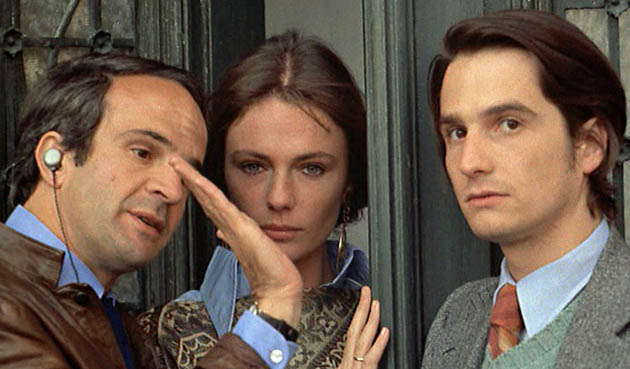 Day for Night, with actor-director François Truffaut, Jacqueline Bisset, and Jean-Pierre Léaud. Back in the 1970s, the now dishearteningly mainstream – or mainstreamish – New York Film Critics made a number of daring choices, e.g., selecting non-English-language arthouse releases as their Best Film for three years in row: Cries and Whispers (1972); Day for Night (1973); and Amarcord (1974). Since those days, the closest the NYFCC has gotten to alternative fare in their Best Film choices have been rarities like Robert Altman’s The Player (1992), Mike Leigh’s Topsy-Turvy (1999), and David Lynch’s Mulholland Dr. (2001).
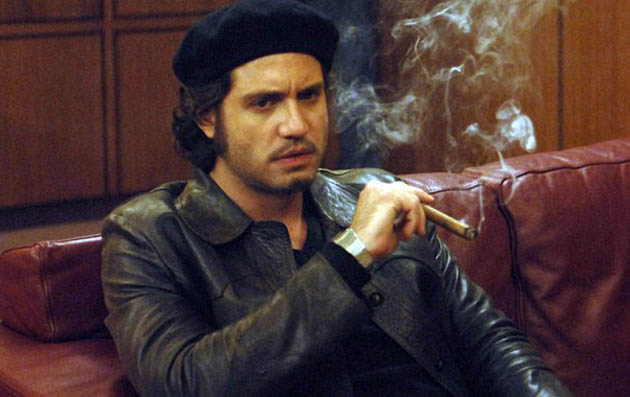 Edgar Ramírez in Carlos. For his portrayal of Venezuelan assassin/terrorist Carlos the Jackal in Olivier Assayas’ French-German biopic/thriller Carlos (originally made as a television miniseries), Venezuelan actor Edgar Ramírez was a possible contender for the New York Film Critics Circle’s Best Actor award. The eventual mainstream winner, however, was Colin Firth for his portrayal of another real-life figure, British King George VI in Tom Hooper’s crowd-pleasing The King’s Speech. Currently serving a life sentence in France, Carlos the Jackal was the inspiration for Edward Fox’s character in Fred Zinnemann’s 1973 thriller The Day of the Jackal.
It bears remembering that in the last 20 years the New York Film Critics have taken a schizophrenic approach to their acting choices, ricocheting back and forth between (mostly) highly commercial Hollywood productions and smaller American indies and British imports – even, however rarely, daring to venture into the dark recesses of the non-English-speaking world.
That’s why one year you get Imelda Staunton in Vera Drake and the next Reese Witherspoon in Walk the Line, followed by Helen Mirren in The Queen. Or Tom Hanks in Cast Away, followed by Tom Wilkinson in In the Bedroom.
Patricia Clarkson is singled out for Far from Heaven in 2002, and then Jennifer Hudson is honored for Dreamgirls in 2006. Later in the decade we have Penélope Cruz in Vicky Cristina Barcelona (2008) and Mo’Nique in Precious (2009) – two indie movies featuring, what else, Oscar favorites (and eventual Oscar winners).
Last year’s winners were Hollywood types George Clooney (Up in the Air & Fantastic Mr. Fox) and Meryl Streep (Julie & Julia), and, in the supporting categories, popular choices Christoph Waltz (Inglourious Basterds) and the aforementioned Mo’Nique.
New York Film Critics Awards Ceremony: Darren Aronofsky vs. Armond White vs. Greenberg
Roger Friedman reports at showbiz411.com that the New York Film Critics Circle (NYFCC) awards ceremony held Monday evening was anything but dull. In attendance were the likes of Michelle Williams, Colin Firth, Melissa Leo, Tom Hooper, Kerry Washington, Mark Ruffalo, Annette Bening, Lisa Cholodenko, Stanley Tucci, Warren Beatty, and Paul Schrader.
Some of the entertainment was provided by Michelle Williams having witnessed Best Supporting Actor winner Mark Ruffalo (The Kids Are All Right) clean up “a kid’s vomit out the backseat of his SUV.” But the highlight of the evening apparently was a little verbal sparring between Black Swan director Darren Aronofsky and NYFCC chairman Armond White.
According to Friedman, Aronofsky, on the podium to present an award to Black Swan cinematographer Matthew Libatique, “took a shot – verbally” at White, who had panned the otherwise widely praised Black Swan and who also happened to be standing behind Aronofsky. Friedman refrains from spelling out the “verbal shot.”
White retorted with a “Darren reads me. That’s all I need.”
There would be more to come from White, perhaps the most reviled film critic in the United States for a variety of reasons, not the least of which was his daring to throw a rotten tomato at the talking toys in Toy Story 3. At the end of the evening, the NYFCC Chair remarked about his fellow critics’ choices: “At least Greenberg didn’t win anything.”
On Twitter, The Village Voice’s Michael Atkinson posted the following about the NYFCC dinner: “Even more of a train wreck than usual. At least Colin Firth was an adept public speaker, because no one else was.”
Darren Aronofsky vs. Armond White
At ew.com, Lisa Schwarzbaum wrote a piece about the New York Film Critics Circle’s Monday night awards ceremony – in the words of The Village Voice’s Michael Atkinson, “even more of a train wreck than usual.”
Two trains collided at the ceremony, NYFCC chairman and evening host Armond White and Black Swan director Darren Aronofsky, who took to the stage to present the Best Cinematography award to Matthew Libatique. I mentioned the White–Aronofsky sparring match in a previous post, but Schwarzbaum provides more details in her piece.
Aronofsky’s verbal swipe at White, who had panned Black Swan, was: “I thought I was giving White the compassion award because if you don’t have something, you should get it. Seriously, keep it up because you give all of us another reason not to read The New York Press.”
White’s response: “That’s all right. Darren reads me. That’s all I want. And because he reads me, he knows the truth.”
Schwarzbaum explains that “the proceedings became ruder from there.” While introducing Tony Kushner to present the Best Picture award to David Fincher’s The Social Network, White, who also panned the film, remarked, “Maybe he can explain why it won best picture.” And as mentioned in my previous post, White ended the proceedings by taking a swipe at Noah Baumbach’s Greenberg: “I thank the Circle for not awarding a single award to Greenberg.”
Schwarzbaum’s summing up of the evening: “Represented by an ungracious spokesman, all critics were made to look as sour and bitter and ungenerous as caricature (and Ratatouille) would have us. Judged by snark from one irritated director, everyone in that business was made to look ungracious.”
She then briefly explains her views on the work of critics, making some valid points. However, I wouldn’t go as far as to say that critics and film industry people necessarily do what they do “for the love of movies [her italics].” Or, for that matter, that critics and film people are “all decent, thoughtful people, working together on the side of art.” Some are; many aren’t.
New York Film Critics Circle website.
Annette Bening The Kids Are All Right image: Suzanne Tenner / Focus Features.
Edgar Ramírez Carlos image: IFC Films.
Jacqueline Bisset, Jean-Pierre Léaud, and François Truffaut Day for Night image: Les Films du Carrosse | Warner Bros.
*last modified November 2025.