
 Farrah Fawcett.

March 10 update: According to People Online, Farrah Fawcett’s family, friends, and fans have received “an apology” from Academy of Motion Picture Arts and Sciences executive director Bruce Davis, who reportedly was responsible for the inclusions and omissions in the “In Memoriam” segment of Sunday’s Academy Awards ceremony. As previously mentioned on this website and elsewhere, Fawcett was left out of the tribute.
Among those criticizing the omission were Jane Fonda, Roger Ebert, and Academy Award-winner Tatum O’Neal, whose father Ryan O’Neal had been Fawcett’s companion. On Tuesday, Tatum O’Neal issued a statement that said:
“On behalf of myself, my father Ryan O’Neal and my entire family, we are deeply saddened that a [sic] truly beautiful and talented actress Farrah Fawcett was not included in the memorial montage during the 82nd Academy Awards. We are bereft with this exclusion of such an international icon who inspired so many for so many reasons. Beautiful, talented Farrah will never be forgotten by her family and amazing fans.”
Fawcett appeared in more than a dozen films, including the 1986 drama Extremities, for which she was touted as a potential Oscar contender. Among those also omitted from the “In Memoriam” segment were Gene Barry, the star of the 1953 science-fiction classic War of the Worlds; 1949 Best Actor nominee Richard Todd, who appeared in more than fifty films; and Bea Arthur, chiefly a television star who had a supporting role in the 1974 musical Mame.
Davis explained the inclusion of Michael Jackson, a talent that is hardly associated with the film world, by saying that Jackson was the star of the successful documentary This Is It. Tough luck for Fawcett that her biggest film hit came out more than twenty years ago, and for Gene Barry and Richard Todd that their biggest film hits came out more than five decades ago.
And before any crazy fan accuses me of being anti-Michael Jackson, that’s not the case at all. I totally agree that it would have been unthinkable not to include Jackson, even though his film work was tangential to his professional success. But since he was in, Fawcett, Todd, and Barry should have been in as well.
March 9
Jean Simmons, who died this past January, was remembered in this year’s In Memoriam segment at the 2010 Oscar ceremony. Well, great. Simmons was a fantastic actress. As far as I’m concerned, she stole Hamlet from Laurence Olivier, Elmer Gantry from Burt Lancaster, and Spartacus from Kirk Douglas.
But why an image of Jennifer Jones in The Song of Bernadette (right) above Simmons’ name? Oops!
That mistake reminded me of another homage a few years back, when on the occasion of the Oscar’s Grand 75th Anniversary the Academy honored every Best Picture, Best Actor, and Best Actress winner with a one-minute (or whereabouts) montage.
The very first actress to win the Oscar was Janet Gaynor, who bagged the statuette for her performances in three movies: Sunrise, 7th Heaven, and Street Angel. The Oscar’s Best Actress montage, however, featured only one of Gaynor’s films: Sunrise. But let’s not be picky. I mean, just imagine if the Oscarcast ran for 3h45m4s as opposed to just 3h45 million.
So, what do the homage creators do to honor Janet Gaynor in Sunrise? Well, they carefully pick a moment from the most famous sequence found in the film. And that’s great. It’s a striking bit.
The only problem is that the woman featured in it is Margaret Livingston, who never won nor was ever nominated for an Oscar.
And that’s how the very first Best Actress Oscar winner was left out of the Oscar’s 75th Anniversary homage to its Best Actresses.

In the 2008 TCM Remembers clip above, you’ll find a collection of film personalities, from Ingmar Bergman star Eva Dahlbeck to Jaws’ Roy Scheider, from Rear Window screenwriter John Michael Hayes to Il Sorpasso director Dino Risi, from silent film actress Anita Page (seen with Joan Crawford) to Black Orpheus’ Breno Mello and Marpessa Dawn, from Oscar winner Paul Scofield to schlock goddess Vampira.
The Oscars could learn from Turner Classic Movies.
One thing that’s always irritating at the Academy’s In Memoriam tribute is that audience members applaud the names they recognize – e.g., Michael Jackson, Brittany Murphy, David Carradine, none of whom was an actual movie star but whose deaths received a lot of publicity – whereas they all but ignore a former Oscar winner and five-time nominee like Jennifer Jones, or an Oscar nominee like Betsy Blair, who also happened to have had a major role in a Best Picture winner.
The segment itself started out clumsily, with a long shot that made it difficult to see who was being honored on the Kodak Theatre’s screen. Turned out it was Patrick Swayze. Inexplicably, it featured Michael Jackson, who never had a career in movies, but not Farrah Fawcett, who in 1986 was touted as a potential Best Actress contender for Extremities, and who had important roles in about a dozen other feature films, including the 1997 drama The Apostle which earned Robert Duvall a Best Actor nod. Also, 1949 Best Actor nominee Richard Todd (The Hasty Heart) was nowhere to be seen.
True, you can’t include everyone who dies in a montage that lasts a few minutes. But did Michael Jackson have a more notable film career than Farrah Fawcett? Did Brittany Murphy or Variety columnist Army Archerd or Arthur Canton (“public relations”) have a more notable film career than Richard Todd?
Both Fawcett and Todd were included in the SAG Awards montage. If the SAG ceremony could find time for them, why not the Oscarcast?
Those people who create the Oscar’s annual homage to the dead should take a good look at how Turner Classic Movies does it. Or even this “Golden Age Actresses” tribute found on YouTube.
March 8
 Kathryn Bigelow and Barbra Streisand.
The 2010 Academy Awards ceremony were watched by an estimated 41.3 million people in the United States, up 14 percent from last year according to the Nielsen Co. The Hurt Locker’s victory over Avatar was seen by more people – in case there were 41.3 million still up by then – than any other Oscarcast since Million Dollar Baby took the Best Picture Oscar in early 2005.
There have been all sorts of explanations for this, among them “a trend” – in 2010 people have suddenly decided they want a “communal experience” in front of their TV sets – that has led to higher ratings for other major televised events this year, from the Golden Globes to the Miss America pageant, from the Tonys to the Super Bowl.
Others say it’s because this year’s Oscar lineup featured a number of major box office attractions, including potential best picture winners Avatar and Inglourious Basterds. The more successful the movies in contention, the bigger the Oscar telecast audience according to common wisdom, which always points out to a record viewership of 57.2 million when James Cameron’s Titanic won in 1998.
Others yet claim that Twitter and Facebook and Oscar forums and chatrooms have made the ceremony more Internet friendly, as people will tweet about how boring some speech was or how ugly this or that actress looked.
Someone somewhere is saying that the ratings increase was all due to the presence of Zac Efron, Kristen Stewart, Taylor Lautner, and Miley Cyrus.
Oscar’s smallest audience in the last 25 years took place in 2008, when an average of 31.7 million people watched the ceremony the night No Country for Old Men won Best Picture.
Photos: Matt Petit | © A.M.P.A.S.
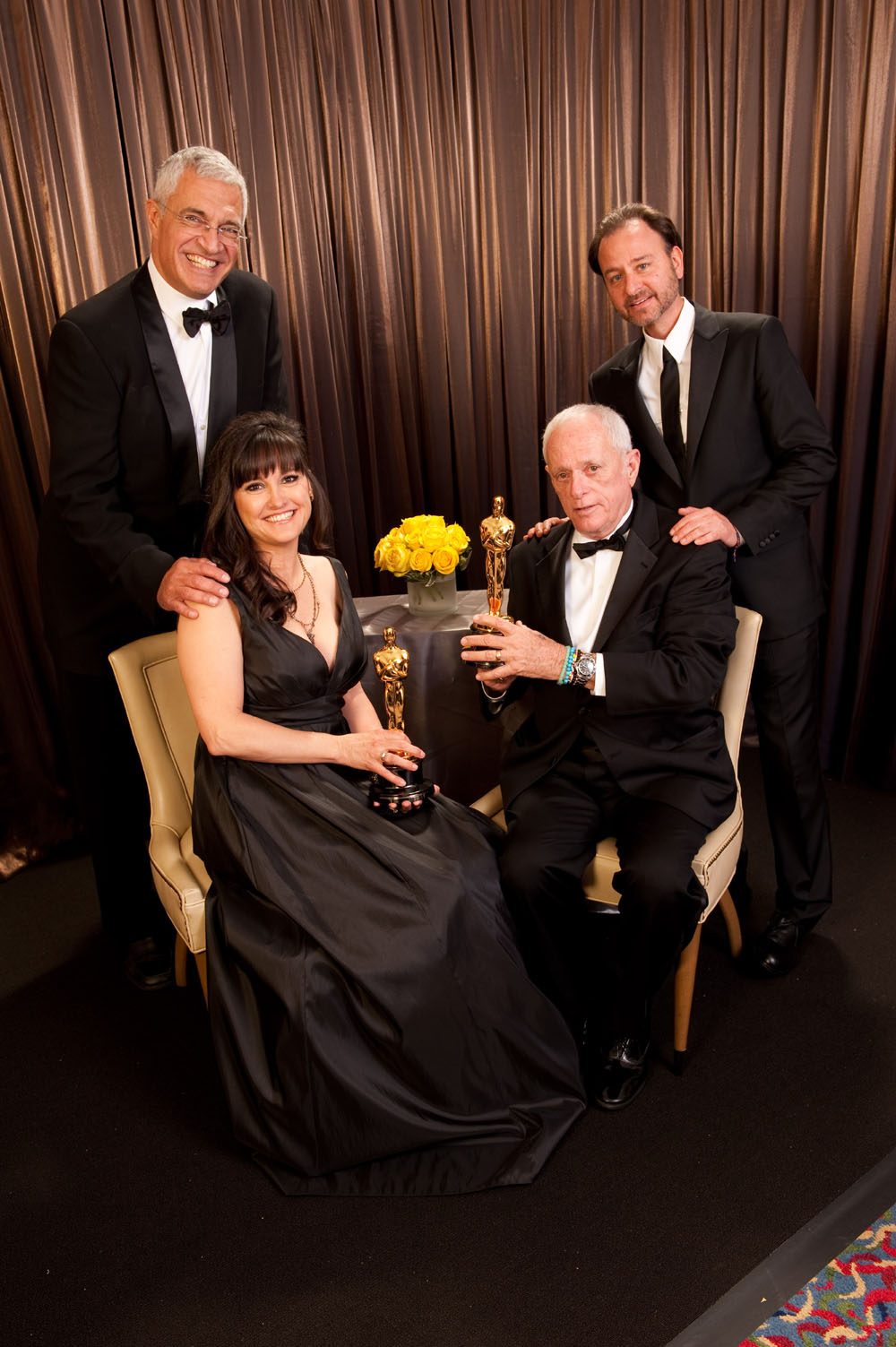
Louie Psihoyos, Paula DuPré Pesman, Fisher Stevens, Ric O’Barry
The Associated Press’ Jay Alabaster writes about the reaction of locals in Taiji, Japan, after the Oscar for Best Documentary went to Louie Psihoyos’ The Cove, an indictment of the dolphin-slaughtering practices of Taiji fishermen – they stab screaming dolphins after herding them in shallow waters near a hidden cove – and how Japanese authorities do nothing to stop them.
The Cove refers to Taiji and its dolphin-killing practices as “a little town with a really big secret,” but local councilman Hisato Ryono says “everyone around here knows about it. The water nearby turns red during the hunt. The actual killing is done in a concealed area because it is unpleasant to look at, as is true of killing cows or pigs or any other animal.”
Sure. But when the film calls Taiji “a little town with a really big secret” that’s in reference to the fact that Taiji locals don’t publicize their bloody practices to the rest of the world. Locals may find the slaughter a fact of life, but according to the Cove filmmakers most Japanese are unaware of it.
Unfortunately, Alabaster’s article makes no mention of mercury levels found in dolphin meat sold in Japan. The article also lacks quotes from Psihoyos or anyone else involved in the making of The Cove.
Here’s Louie Psihoyos talking about Taiji in an interview published in Mother Jones in August 2009:
“It was like walking into a Stephen King novel. Everywhere you go there are statues of whales and dolphins. There are signs that say, ‘We love dolphins.’ But in the center of town is this horror show. Right between the whaling museum and City Hall. It’s in a national park! If you were to write this as a novel, people would say it was too over the top. My journalistic instincts turned on. I thought, this is a great story. But here’s the problem: All the dirty business happens in this secret cove, but you can’t see it. People have been coming for decades to try to document it. At that point, I realized I was no longer just a journalist covering a story. By trying to get into the cove, I was becoming an activist.”
According to Alabaster’s report, Taiji fishermen have been hunting whales and dolphins since the 1600s. Some will see that as a justification for continuing the indiscriminate killing of sea mammals. Personally, I’ve always believed that the world would be an infinitely better place if unethical traditions were left in the past. Taiji’s dolphin-slaughtering just proves my point.
The Cove will have a limited release in Japan in June.
Photo: Todd Wawrychuk | © A.M.P.A.S.
in-memoriam-2010